The Threat of Authoritarianism in the U.S. is Very Real, and Has Nothing To Do With Trump
The
COVID-driven centralization of economic power and information control
in the hands of a few corporate monopolies poses enduring threats to
political freedom.
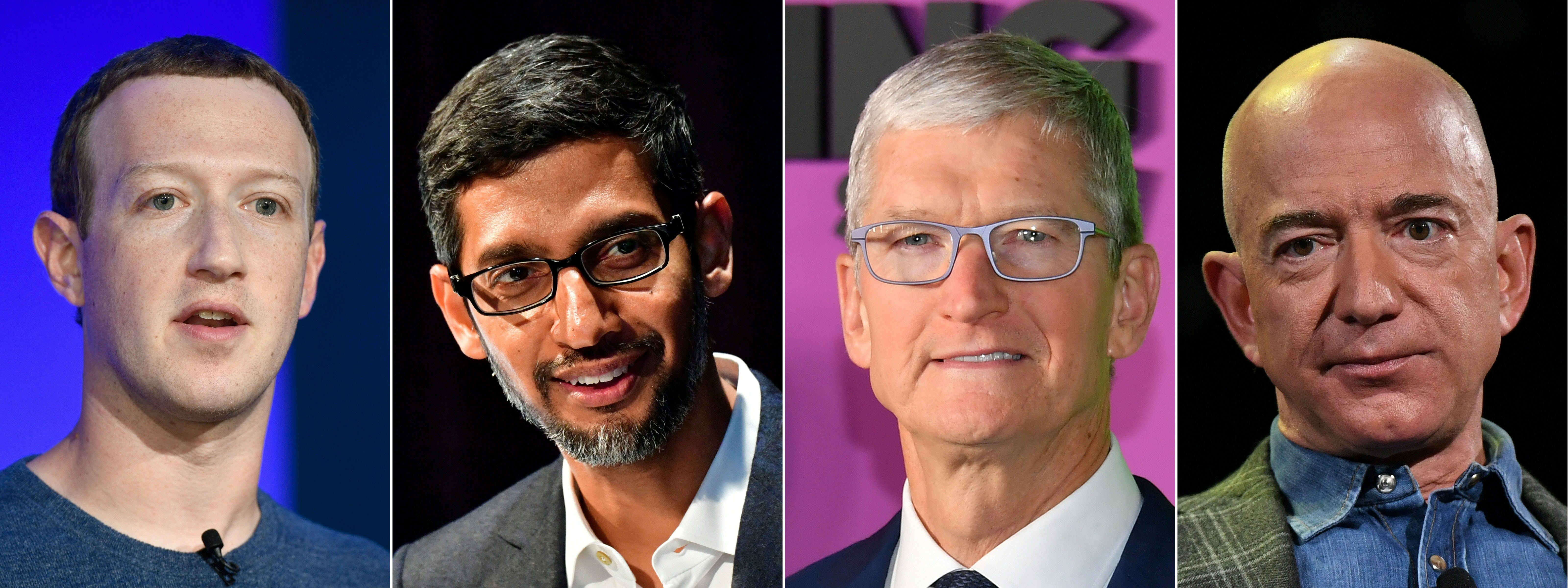
(L-R):
Facebook CEO Mark Zuckerberg, Google CEO Sundar Pichai, Apple CEO Tim
Cook and Amazon Founder and CEO Jeff Bezos (Photo by BERTRAND
GUAY,TOBIAS SCHWARZ,ANGELA WEISS,MARK RALSTON/AFP via Getty Images)
Asserting that Donald Trump
is a fascist-like dictator threatening the previously sturdy
foundations of U.S. democracy has been a virtual requirement over the
last four years to obtain entrance to cable news Green Rooms, sinecures
as mainstream newspaper columnists, and popularity in faculty lounges.
Yet it has proven to be a preposterous farce.
In 2020 alone,
Trump had two perfectly crafted opportunities to seize authoritarian
power — a global health pandemic and sprawling protests and sustained
riots throughout American cities — and yet did virtually nothing to
exploit those opportunities. Actual would-be despots such as Hungary’s
Viktor Orbán quickly seized on the virus to declare martial law, while even prior U.S. presidents,
to say nothing of foreign tyrants, have used the pretext of much less
civil unrest than what we saw this summer to deploy the military in the
streets to pacify their own citizenry.
But early in the pandemic, Trump was criticized, especially by Democrats, for failing to
assert the draconian powers he had, such as commandeering the means of
industrial production under the Defense Production Act of 1950, invoked
by Truman to force industry to produce materials needed for the Korean
War. In March, The Washington Postreported
that “Governors, Democrats in Congress and some Senate Republicans have
been urging Trump for at least a week to invoke the act, and his
potential 2020 opponent, Joe Biden, came out in favor of it, too,” yet
“Trump [gave] a variety of reasons for not doing so.” Rejecting demands
to exploit a public health pandemic to assert extraordinary powers is
not exactly what one expects from a striving dictator.
A similar
dynamic prevailed during the sustained protests and riots that erupted
after the killing of George Floyd. While conservatives such as Sen. Tom
Cotton (R-AK), in his controversial New York Times op-ed, urged
the mass deployment of the military to quell the protesters, and while
Trump threatened to deploy them if governors failed to pacify the riots,
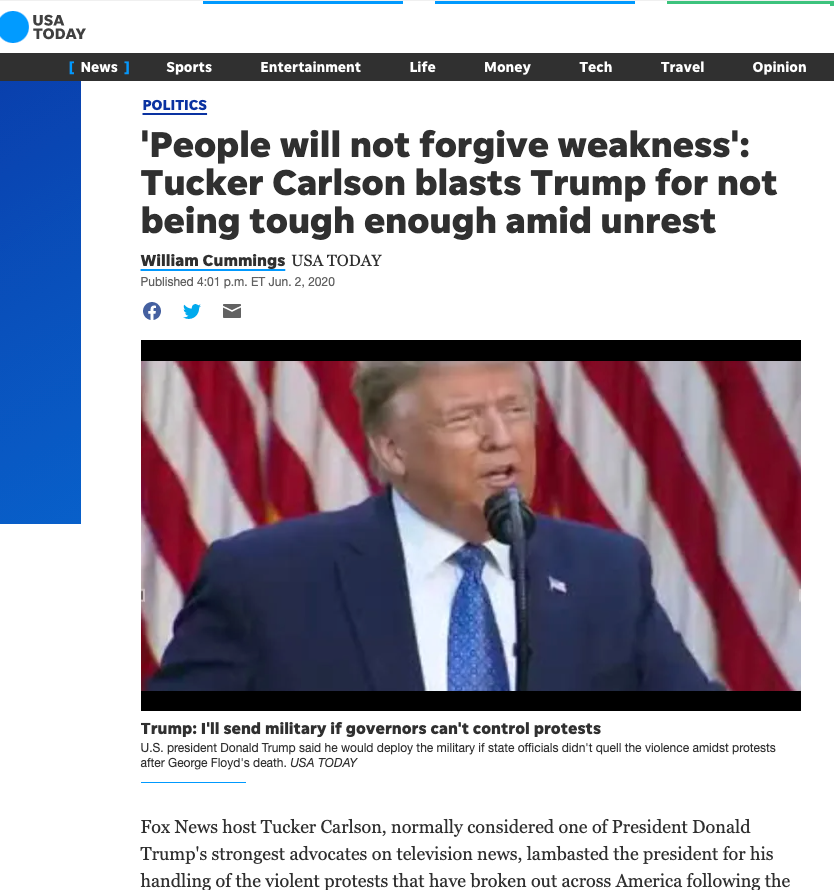
Trump failed to order anything more than a few isolated, symbolic
gestures such as having troops use tear gas to clear out protesters from
Lafayette Park for his now-notorious walk to a church, provoking harsh criticism from the right, including Fox News, for failing to use more aggressive force to restore order.
USA Today, June 2, 2020
Virtually
every prediction expressed by those who pushed this doomsday narrative
of Trump as a rising dictator — usually with great profit for themselves
— never materialized. While Trump radically escalated bombing campaigns
he inherited from Bush and Obama, he started no new wars. When his
policies were declared by courts to be unconstitutional, he either
revised them to comport with judicial requirements (as in the case of his “Muslim ban”) or withdrew them
(as in the case of diverting Pentagon funds to build his wall). No
journalists were jailed for criticizing or reporting negatively on
Trump, let alone killed, as was endlessly predicted and sometimes even
implied. Bashing Trump was far more likely to yield best-selling books,
social media stardom and new contracts as cable news “analysts” than
interment in gulags or state reprisals. There were no Proud Boy
insurrections or right-wing militias waging civil war in U.S. cities.
Boastful and bizarre tweets aside, Trump’s administration was far more a
continuation of the U.S. political tradition than a radical departure
from it.
The hysterical Trump-as-despot script was all melodrama,
a ploy for profits and ratings, and, most of all, a potent instrument
to distract from the neoliberal ideology that gave rise to Trump in the
first place by causing so much wreckage. Positing Trump as a grand
aberration from U.S. politics and as the prime author of America’s woes —
rather than what he was: a perfectly predictable extension of U.S
politics and a symptom of preexisting pathologies — enabled
those who have so much blood and economic destruction on their hands not
only to evade responsibility for what they did, but to rehabilitate
themselves as the guardians of freedom and prosperity and, ultimately,
catapult themselves back into power. As of January 20, that is exactly
where they will reside.
The Trump administration was by no means
free of authoritarianism: his Justice Department prosecuted journalists’
sources; his White House often refused basic transparency; War on
Terror and immigration detentions continued without due process. But
that is largely because, as I wrote in a Washington Post op-ed in late 2016,
the U.S. Government itself is authoritarian after decades of bipartisan
expansion of executive powers justified by a posture of endless war.
With rare exception, the lawless and power-abusing acts over the last
four years were ones that inhere in the U.S. Government and long
preceded Trump, not ones invented by him. To the extent Trump was an
authoritarian, he was one in the way that all U.S. presidents have been
since the War on Terror began and, more accurately, since the start of
the Cold War and advent of the permanent national security state.
The
single most revealing episode exposing this narrative fraud was when
journalists and political careerists, including former Obama aides,
erupted in outrage on social media upon seeing a photo of immigrant
children in cages at the border — only to discover
that the photo was not from a Trump concentration camp but an Obama-era
detention facility (they were unaccompanied children, not ones
separated from their families, but “kids in cages” are “kids in cages”
from a moral perspective). And tellingly, the single most actually
authoritarian Trump-era event is one that has been largely ignored by
the U.S. media: namely, the decision to prosecute Julian Assange under
espionage laws (but that, too, is an extension of the unprecedented war
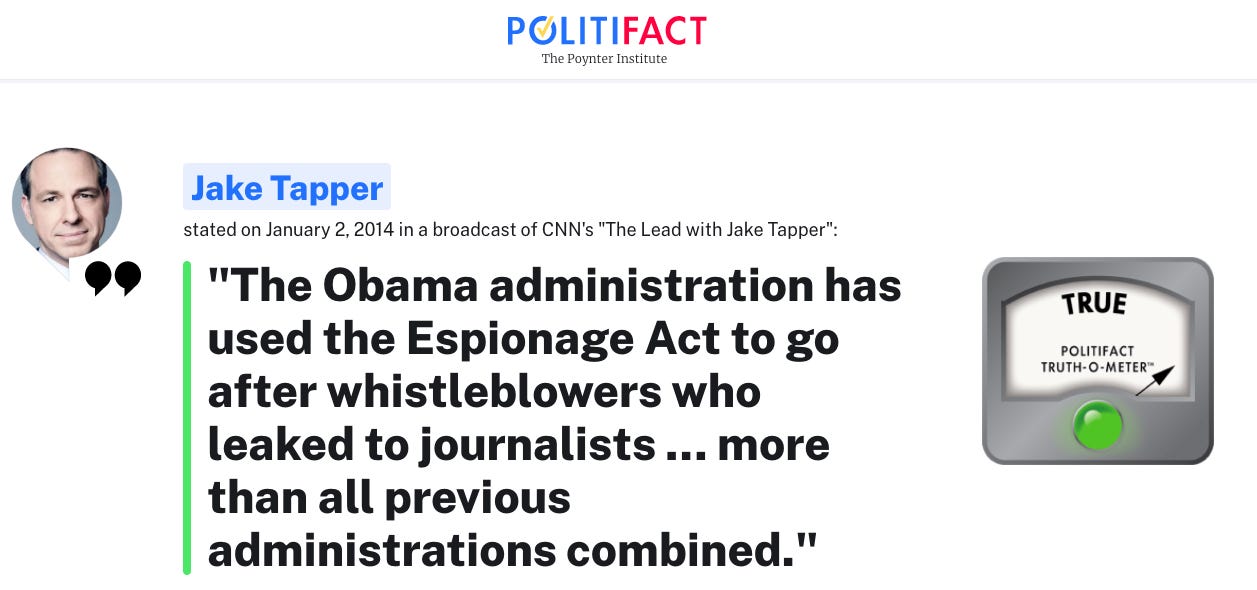
on journalism unleashed by the Obama DOJ).
PolitiFact, Jan. 10, 2014
The
last gasp for those clinging to the Trump-as-dictator fantasy (which
was really hope masquerading as concern, since putting yourself on the
front lines, bravely fighting domestic fascism, is more exciting and
self-glorifying, not to mention more profitable, than the dreary,
mediocre work of railing against an ordinary and largely weak one-term
president) was the hysterical warning that Trump was mounting a coup in
order to stay in office. Trump’s terrifying “coup” consisted of a series
of failed court challenges based on claims of widespread voter fraud —
virtually inevitable with new COVID-based voting rules never previously
used — and lame attempts to persuade state officials to overturn
certified vote totals. There was never a moment when it appeared even
remotely plausible that it would succeed, let alone that he could secure
the backing of the institutions he would need to do so, particularly
senior military leaders.
Whether Trump secretly harbored despotic
ambitions is both unknowable and irrelevant. If he did, he never
exhibited the slightest ability to carry them out or orchestrate a
sustained commitment to executing a democracy-subverting plot. And the
most powerful U.S. institutions — the intelligence community and
military brass, Silicon Valley, Wall Street, and the corporate media —
opposed and subverted him from the start. In sum, U.S. democracy, in
whatever form it existed when Trump ascended to the presidency, will
endure more or less unchanged once he leaves office on January 20, 2021.
Whether the U.S. was a democracy in any meaningful sense prior to Trump had been the subject of substantial scholarly debate. A much-discussed 2014 study
concluded that economic power has become so concentrated in the hands
of such a small number of U.S. corporate giants and mega-billionaires,
and that this concentration in economic power has ushered in virtually
unchallengeable political power in their hands and virtually none in
anyone else’s, that the U.S. more resembles oligarchy than anything else:
The
central point that emerges from our research is that economic elites
and organized groups representing business interests have substantial
independent impacts on U.S. government policy, while mass-based interest
groups and average citizens have little or no independent influence.
Our results provide substantial support for theories of Economic-Elite
Domination and for theories of Biased Pluralism, but not for theories of
Majoritarian Electoral Democracy or Majoritarian Pluralism.
The U.S. Founders most certainly did not envision or desire absolute economic egalitarianism, but many, probably most, feared
— long before lobbyists and candidate dependence on corporate SuperPACs
— that economic inequality could become so severe, wealth concentrated
in the hands of so few, that it would contaminate the political realm, where those vast wealth disparities would be replicated, rendering political rights and legal equality illusory.
But
the premises of pre-Trump debates over how grave a problem this is have
been rendered utterly obsolete by the new realities of the COVID era. A
combination of sustained lockdowns, massive state-mandated transfers of wealth
to corporate elites in the name of legislative “COVID relief,” and a
radically increased dependence on online activities has rendered
corporate behemoths close to unchallengeable in terms of both economic and political power.
The
lockdowns from the pandemic have ushered in a collapse of small
businesses across the U.S. that has only further fortified the power of
corporate giants. “Billionaires increased their wealth by more than a
quarter (27.5%) at the height of the crisis from April to July, just as
millions of people around the world lost their jobs or were struggling
to get by on government schemes,” reportedThe Guardian in September. A study from July told part of the story:
The
combined wealth of the world's super-rich reached a new peak during the
coronavirus pandemic, according to a study published by the consulting firm PwC and the Swiss bank UBC on
Wednesday. The more than 2,000 billionaires around the world managed to
amass fortunes totalling around $10.2 trillion (€8.69 trillion) by
July, surpassing the previous record of $8.9 trillion reached in 2017.
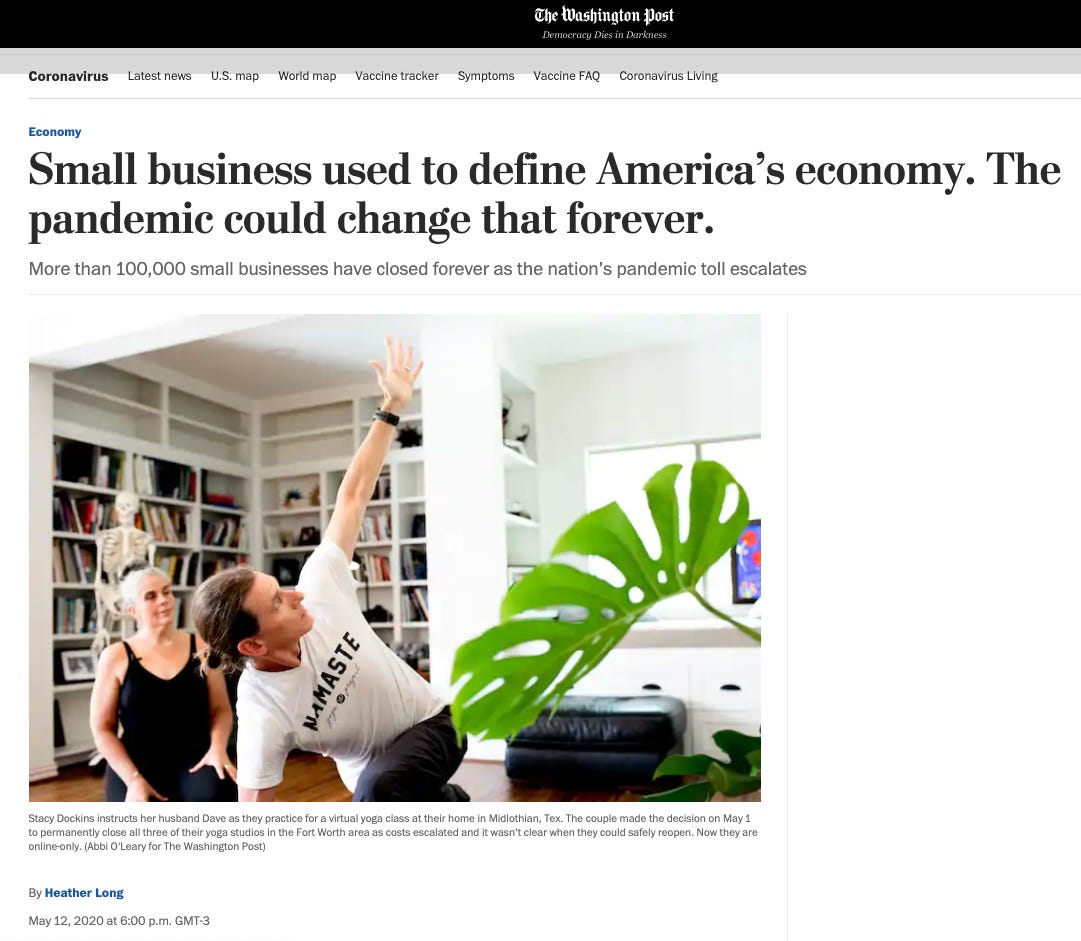
Meanwhile, though exact numbers are unknown, “roughly one in five small businesses have closed,” APnotes,
adding: “restaurants, bars, beauty shops and other retailers that
involve face-to-face contact have been hardest hit at a time when
Americans are trying to keep distance from one another.”
Washington Post, May 12, 2020
Employees
are now almost completely at the mercy of a handful of corporate giants
which are thriving, far more trans-national than with any allegiance to
the U.S. A Brookings Institution study this week
— entitled “Amazon and Walmart have raked in billions in additional
profits during the pandemic, and shared almost none of it with their
workers” — found that “the COVID-19 pandemic has generated record
profits for America’s biggest companies, as well as immense wealth for
their founders and largest shareholders—but next to nothing for
workers.”
These COVID “winners” are not the Randian victors in
free market capitalism. Quite the contrary, they are the recipients of
enormous amounts of largesse from the U.S. Government, which they
control through armies of lobbyists and donations and which therefore
constantly intervenes in the market for their benefit. This is not free
market capitalism rewarding innovative titans, but rather crony
capitalism that is abusing the power of the state to crush small
competitors, lavish corporate giants with ever more wealth and power,
and turn millions of Americans into vassals whose best case scenario is
working multiple jobs at low hourly wages with no benefits, few rights,
and even fewer options.
Those must disgusted by this outcome
should not be socialists but capitalists: this is a classic merger of
state and corporate power —- also known as a hallmark of fascism in its
most formal expression — that abuses state interference in markets to
consolidate and centralize authority in a small handful of actors in
order to disempower everyone else. Those trends were already quite
visible prior to Trump and the onset of the pandemic, but have
accelerated beyond anyone’s dreams in the wake of mass lockdowns,
shutdowns, prolonged isolation and corporate welfare thinly disguised as
legislative “relief.”
What makes this most menacing
of all is that the primary beneficiaries of these rapid changes are
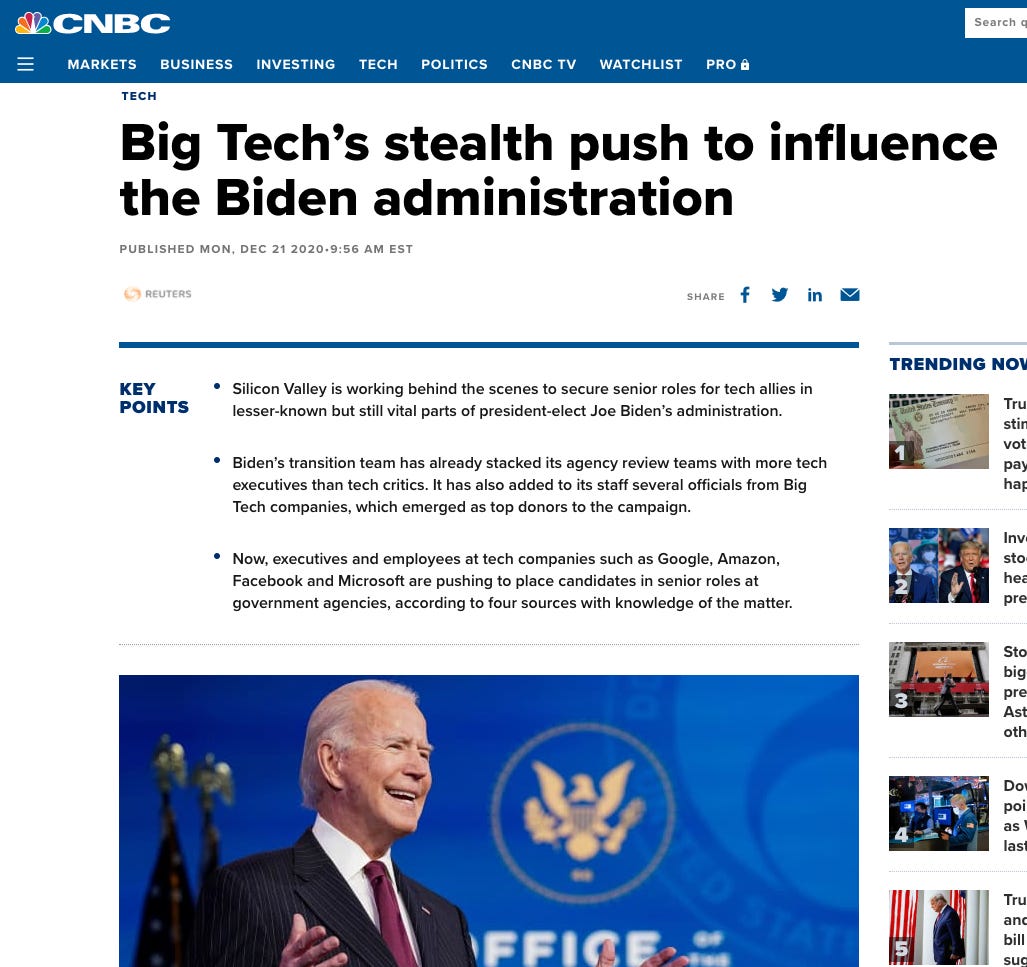
Silicon Valley giants, at least three of which — Facebook, Google, and
Amazon — are now classic monopolies.
That the wealth of their primary owners and executives — Mark
Zuckerberg, Jeff Bezos, Sundar Pichai — has skyrocketed during the
pandemic is well-covered, but far more significant is the unprecedented
power these companies exert over the dissemination of information and
conduct of political debates, to say nothing of the immense data they
possess about our lives by virtue of online surveillance.
Stay-at-home
orders, lockdowns and social isolation have meant that we rely on
Silicon Valley companies to conduct basic life functions more than ever
before. We order online from Amazon rather than shop; we conduct
meetings online rather than meet in offices; we use Google constantly to
navigate and communicate; we rely on social media more than ever to
receive information about the world. And exactly as a weakened
population’s dependence on them has increased to unprecedented levels,
their wealth and power has reached all new heights, as has their
willingness to control and censor information and debate.
That
Facebook, Google and Twitter are exerting more and more control over our
political expression is hardly contestable. What is most remarkable,
and alarming, is that they are not so much grabbing these powers as
having them foisted on them, by a public — composed primarily of
corporate media outlets and U.S. establishment liberals — who believe
that the primary problem of social media is not excessive censorship but
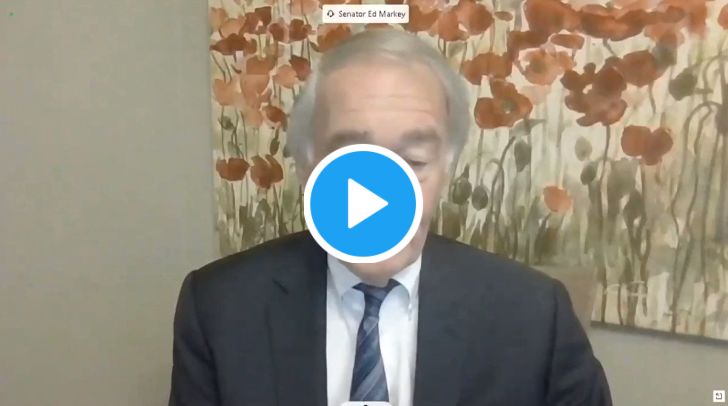
insufficient censorship. As Sen. Ed Markey (D-MA) told Mark
Zuckerberg when four Silicon Valley CEOs appeared before the Senate in
October: "The issue is not that the companies before us today is that
they're taking too many posts down. The issue is that they're leaving
too many dangerous posts up."
As I told the online program Rising this week when asked what the worst media failings of 2020 are, I continue to view the brute censorship by Facebook
of incriminating reporting about Joe Biden in the weeks before the
election as one of the most significant, and menacing, political events
of the last several years. That this censorship was announced by a
Facebook corporate spokesman who had spent his career previously as a
Democratic Party apparatchik provided the perfect symbolic expression of
this evolving danger.
The
Biden/Harris administration clearly intends to do a great deal for
Silicon Valley, and Silicon Valley is well-positioned to do a great deal
for them in return, starting with their immense power over the flow of
information and debate.
The
dominant strain of U.S. neoliberalism — the ruling coalition that has
now consolidated power again — is authoritarianism. They view those who
oppose them and reject their pieties not as adversaries to be engaged
but as enemies, domestic terrorists, bigots, extremists and
violence-inciters to be fired, censored, and silenced. And they have on
their side — beyond the bulk of the corporate media, and the
intelligence community, and Wall Street — an unprecedentedly powerful
consortium of tech monopolies willing and able to exert greater control
over a population that has rarely, if ever, been so divided, drained,
deprived and anemic.
All of these authoritarian powers will,
ironically, be invoked and justified in the name of stopping
authoritarianism — not from those who wield power but from the movement
that was just removed from power. Those who spent four years shrieking
to great profit about the dangers of lurking “fascism” will — without
realizing the irony — now use this merger of state and corporate power
to consolidate their own authority, control the contours of permissible
debate, and silence those who challenge them even further. Those most
vocally screaming about growing authoritarianism in the U.S. over the
last four years were very right in their core warning, but very wrong
about the real source of that danger.
ANOTHER opinion piece, Glenn? No new news reported?
I certainly agree with your perspective, but DUH!
How about INVESTIGATING and REPORTING real news, for once.
How
about INVESTIGATING and REPORTING on all the shocking evidence
contained in HUNDREDS of affidavits from election workers presenting
evidence of ELECTION FRAUD when the MSM claims there is "no evidence" ?
How about INVESTIGATING and REPORTING on the contents of Hunter Biden's laptop ?
Appreciate
the work Glenn. I find it hard not to be demoralized daily with the
knowledge that even attempting civil conversation on this very issue
(the primary reason I supported Trump over the Democrats after
previously never supporting a republican party candidate) will get me
lambasted even at home for even considering that Trump was not that bad.
That we could and are doing by giving the reigns to someone as corrupt
as Biden (China) or as fake as Kamala. The smear campaign of the
establishment was so effective that was it clear and obvious fake
platitudes and politicking coming from Biden/Harris is eaten up like
candy in light of the orange man being bad narrative.
I
still consider myself a liberal, but I also recognize that there are
other ways to address problems because one viewpoint can't have all the
answers to all the social and economic ills of a country. It would be
stupid to think otherwise. I see what the policies of one party have
historically been doing to the many major cities and it just seems like
commone sense to give the other guys a shot, since what has been tried
clearly isn't working and may not be intended to work in the first
place. But if the people want despots I guess they get what they asked
for and deserve.
This is just depressing. I dont
know how to get beyond this. Where has BLM gone since the summer?
Silence. Yet the people who praised and defended their antics are just
as silent. No orange man tp rally against. No more funds to be raised
for democrat candidates, rather than local communities that could use
them.
What does it take to get the average person to realize they are wrong about something?
The Decline and Fall of the Roman Empire audiobook
by Edward Gibbon (1737-1794)
http://free-audio-books.info/history/...
The History of The Decline and Fall of the Roman Empire, a major literary achievement of the 18th century published in six volumes, was written by the celebrated English historian Edward Gibbon. \\
Volume I was published in 1776, and went through six printings (a remarkable feat for its time). Volumes II and III were published in 1781; volumes IV, V, VI in 1788-89.
The original volumes were published as quartos, a common publishing practice of the time.
The books cover the period of the Roman Empire after Marcus Aurelius, from just before 180 to 1453 and beyond, concluding in 1590.
They take as their material the behaviour and decisions that led to the decay and eventual fall of the Roman Empire in the East and West, offering an explanation for why the Roman Empire fell.
Gibbon is sometimes called the first "modern historian of ancient Rome." By virtue of its mostly objective approach and highly accurate use of reference material, Gibbon's work was adopted as a model for the methodologies of 19th and 20th century historians. (Summary from Wikipedia)
" Biden will be our next president. But he will face Nemesis
in a way that few other presidents have ever encountered the cruel
Greek god.
Biden’s hubris and that of the media/Democratic Party fusion
almost guarantee such divine retribution.
Once the last of the other Democratic-primary candidates dropped out
and Biden was nominated, all prior negative media stories about
his
apparent cognitive decline and his family’s financial entanglements
disappeared. From April 2020 on, a virtual news blackout surrounded
Biden. His rare interviews were scripted. Biden
communiqués were
teleprompted. Press conferences were either nonexistent or revolved
around his favorite milkshake or his socks.
Mentions of Hunter Biden’s business dealings in China and Ukraine
were taboo. It was sinful to reference reports of a Hunter Biden
email
allegedly detailing a 10 percent distribution of such revenue to the
“Big Guy” — identified as Joe Biden by Hunter Biden’s business partner.
Unlike Donald Trump, Joe Biden never really campaigned. After the
primaries, he outsourced his fall 2020 campaign to subordinates and pet
journalists to attack Trump.
So is Biden the centrist old Joe from Scranton, or the recently
reinvented hard-left running mate of Kamala Harris? Both or
neither?
Will he keep the booming pre-COVID-19 Trump economy to claim as his own?
Or will he go full socialist to apply a Bernie Sanders–style makeover
to it?
Watch: 0:34
President Trump May Skip Biden’s Inauguration
A President Biden cannot avoid the press forever. He will soon face
unscripted meetings with foreign leaders. He will have to meet
dozens of
movers and shakers each week. Is he or the nation prepared for the
consequences of his return to normality after nearly a year of media
fawning and forced isolation?
To win, the Democrats knowingly drafted the 77-year-old Biden (who
has since turned 78) to put a familiar veneer on radical agendas that
had frightened primary voters. At times, Democrats seemed
fated to be
directly tied to the statue toppling, protesting, rioting, and violence
that plagued American cities for much of the summer.
Given the Democrats’ Faustian bargain with their leftmost faction,
destructive rumors about Biden’s faculties or his family’s financial
escapades will more likely come from his own party’s left wing,
eager
for a Harris presidency, rather than from the Republican opposition.
Biden will enter office with an ethical cloud hanging over his head —
one that could have been vetted and adjudicated rather than blacked out
for most of 2020. His son, brother, and perhaps family
associates may
talk if faced with FBI and IRS probes, if not a special-counsel
investigation.
But that precedent ended with the ill-conceived Robert Mueller
investigation. By spring, Biden could have done to him what was done to
Trump — and what Biden himself so frequently cheered on.
Nor do we impeach presidents often, especially knowing that the
Senate will acquit them when there is no alleged crime as outlined in
the Constitution. That bar is also gone. Should the Republicans hold the
Senate and take the House in 2022, they could do what the Democrats did
in 2020. But if they were to impeach Biden as a possible beneficiary of
his family’s foreign influence-peddling, a Republican-controlled Senate
might not so easily acquit him.
Biden variously called Trump supporters “ugly folk” and “chumps.” He
compared the president to Joseph Goebbels, Adolf Hitler’s Nazi
propagandist. Biden smeared Trump by referring to him as the nation’s
first racist president.
Half the nation will take some time to forget all that. The repair of
warped protocols will take longer, given that the Left forgot the
ancient Thucydidean warning to us not to destroy the very institutions
whose protections we may one day need.
Biden should hope that a rogue FBI does not conduct freelance
investigations of him the way it did of Trump. Let Biden pray there is
not a partisan medical community to diagnose him as impaired and suited
for 25th Amendment removal, as was the case with Trump.
Biden should hope that if Republicans hold the Senate in January,
they do not mimic the Democratic habit of voting against nearly every
Trump nominee. If they were to do that as a majority party in both
chambers of Congress, Biden would have trouble confirming even a single
judge.
So let us celebrate Biden’s call to unity.
But Biden should hope that the opposition will not do to him and his party what the Democrats did so bitterly to Trump.
t his is the first video in a series of lectures from George Grant to go up in the Atheneum playlist. George Grant's first lecture from his CBC Massey lecture series titled "Time as History" given in 1969.
In this lecture series, Grant takes up the crisis of the modern West as a crisis of who we are and what we are becoming. Engaging with the
thought of Friedrich Nietzsche, Grant explicates the concept of time as history and argues that it is not a conception in which one can live a fully human life.
I am citing the Wikipedia article about this unknown or forgotten Canadian thinker. If anyone is interested it's always to read the works (listed below) for yourself than to rely on summaries which are not always nearly accurate. However they are often useful as directions or introductions, but not necessarily on the mark!
George Parkin GrantOCFRSC (1918–1988) was a Canadian philosopher and political commentator. He is best known for his Canadian nationalism, political conservatism, and his views on technology, pacifism, and Christian faith. He is often seen as one of Canada's most original thinkers.
Although he is considered the main theoretician of red Toryism,
he expressed dislike of the term when applied to his deeper
philosophical interests, which he saw as his primary work as a thinker.[7] Recent research on Grant uncovers his debt to a neo-Hegelianidealist tradition, Canadian idealism, that had a major influence on many Canadian scholars and Canadian political culture more broadly.[8]
Grant was born in Toronto on 13 November 1918, the son of Maude Erskine (née Parkin) and William Lawson Grant.[9] He came from a distinguished Canadian family of scholars and educators. His father was the principal of Upper Canada College, and his paternal grandfather George Monro Grant was the dynamic principal of Queen's University. His maternal grandfather was Sir George Robert Parkin, also a principal at Upper Canada College, whose daughter Alice married Vincent Massey, the Canadian diplomat and first Canadian-born Governor General of Canada.[citation needed]
Both of his grandfathers were vehement proponents of the bonds between
Canada and the British Empire, and this greatly influenced their
grandson.[10] His nephew is public scholar and former Leader of the Opposition in the Canadian House of Commons, Michael Ignatieff.[11] On 1 July 1947 he married Sheila Allen[12] whom he had met at Oxford.
Education and teaching
Grant was educated at Upper Canada College and Queen's University from which he graduated with a history degree.[13] He attended Balliol College at the University of Oxford on a Rhodes Scholarship, a trust his grandfather, George Parkin, had headed at one time.[14] Upon winning the Rhodes Scholarship, he enrolled towards a degree in law at Oxford,[15] but after the Second World War ended, and Grant had experienced a deeper personal bond with Christianity, he decided to change studies. His Doctor of Philosophy research was interrupted by the war, and he was already teaching in Dalhousie University's philosophy department when he completed his thesis, The Concept of Nature and Supernature in the Theology of John Oman, during a year-long sabbatical in 1950. Grant was a faculty member at Dalhousie twice (1947–1960, 1980–1988), York University (1960–1961; he resigned before teaching) and McMaster University's religion department (1961–1980), which he founded and led in the 1960s and early 1970s.[16] In 1977, he became an editorial advisor of the journal Dionysius,[citation needed] which published his essay "Nietzsche and the Ancients: Philosophy and Scholarship" in 1979.[17]
In George Grant: A Biography his struggles as a self-taught philosopher are highlighted.[16]
Grant was not readily accepted into the traditional academic
community of scholars in Canada. Resistance was provoked by some of
Grant's less "progressive" stances, most notably the definition of
philosophy he published in 1949: "The study of philosophy is the
analysis of the traditions of our society and the judgment of those
traditions against our varying intuitions of the Perfections of God".
Especially angered and upset was Fulton Anderson of the University of Toronto's
philosophy department. Grant's definition is telling, in that it marks
his unique take on the philosophy's human perspective, which did not
necessarily include assumptions regarding the objectivity of science, or
the blind acceptance of the Enlightenment's fact–value distinction.
Throughout his career Grant was seen as a unique voice within
academic institutions, and thus had strong appeal beyond the strict
"community of scholars". In fact, Grant criticized the trend in
universities to move away from the "unity" of the traditional academy
to a "multi-versity" comprising separate hives of undergraduate
students, graduate students, professional faculties, and professors
(years before the American Allan Bloom would become famous for similar themes).[18]
In 1965 Grant published his most widely known work, Lament for a Nation, in which he deplored what he claimed was Canada's inevitable cultural absorption by the United States,[19]
a phenomenon he saw as an instance of "continentalism". He argued that
the homogenizing effect in current affairs during the period when it was
written would see the demise of Canadian cultural nationality. The
importance of the text is reflected in its selection in 2005 as one of The Literary Review of Canada's 100 most important Canadian books. Grant articulated a political philosophy which was becoming known as red Toryism. It promoted the collectivist and communitarian aspects of an older English conservative tradition, which stood in direct opposition to the individualist traditions of liberalism and subsequently neo-liberalism.[20]
The subjects of his books, essays, public lectures, and radio
addresses (many on CBC Radio in Canada) quite frequently combined
philosophy, religion, and political thought. Grant strongly critiqued
what he believed were the worst facets of modernity, namely unbridled technological advancement and a loss of moral foundations to guide humanity. He defined philosophy as the search for the "purpose and meaning and unity [of] life".[21] What he proposed in place of the modern spirit was a synthesis of Christian and Platonic thought which embodied contemplation of the "good". It is a synthesis that was given form by his neo-HegelianCanadian idealism, which had been a part of his upbringing (his grandfather had been student of John Caird and a close friend of John Watson) but only really took explicit form when he was introduced to Hegel's work by James Doull.[8]
His first book, Philosophy in the Mass Age (1959), was his most explicitly Hegelian book. It began as a series of CBC
lectures, and in it he posed the question of how human beings can
reconcile moral freedom with acceptance of the view that an order exists
in the universe beyond space and time. He applied a neo-Hegelian
concept of history to the modern dilemma of reconciling freedom and
order.[22]
He saw history as the progressive development of humanity's
consciousness of freedom and argued that Canada's unique combination of
British traditional institutions and American individualism put it at
the forefront of this final stage of history. In 1965, furious that the
Liberal government had agreed to accept nuclear weapons, he published Lament for a Nation. At this point, Grant had been influenced by Leo Strauss
and his neo-Hegelian conception of historical progress became more
restrained, losing the hope that we had reached or were on the verge of
reaching the fullest consciousness of freedom. Lament for a Nation
created a sensation with its argument that Canada was destined to
disappear into a universal and homogeneous state whose centre was the
United States. The idea of progress had lost its connection to our moral
development and had been co-opted into a utilitarian mastery of nature
to satisfy human appetites. Technology and Empire (1969), a collection of essays edited by poet and friend Dennis Lee, deepened his critique of technological modernity;[citation needed] and Time as History, his 1969 Massey Lecture,[23] explained the worsening predicament of the West through an examination of the thought of Friedrich Nietzsche. Grant's works of the 1960s had a strong influence on the nationalist movement of the 1970s, though many of the New Left were uncomfortable with Grant's conservatism, his conventional AnglicanTory beliefs, Christian-Platonist perspective, and his uncompromising position against abortion.[24]
Grant's last work was Technology and Justice (1986), which he prepared together with his wife, Sheila Grant. His three-decades-long meditation on French philosopher Simone Weil's
works led to the conclusion that there were fundamental moral and
spiritual flaws in Western civilization, consigning it to a fate of
inevitable collapse. Nevertheless, Grant affirmed his belief that a
better civilization could eventually replace it.[25]
In 2005 Grant's book Lament for a Nation: The Defeat of Canadian Nationalism was voted one of The Literary Review of Canada's 100 most important Canadian books.[27]
Archives
The
George Grant fonds is held by Library and Archives Canada. The archival
reference number is R4526; the former archival reference number is
MG31-D75. The fonds consists of 6 metres of textual records, 25
photographs, and a small amount of other media.[28] The description includes a finding aid.
Technology and Empire : Perspectives on North America. Anansi, (1969)
English-speaking Justice. Mount Allison University, (1974).
Grant, G.P. (1976). "The Computer Does Not Impose on Us the Ways It Should Be Used". In W. Christian & S. Grant (Eds.), The George Grant Reader. Toronto, Ontario, Canada: University of Toronto Press
Technology and Justice. Anansi, (1986).
George Grant: selected letters edited, with an introduction by William Christian. University of Toronto Press, (1996).
The George Grant Reader. William Christian and Sheila Grant (editors). University of Toronto Press, (1998)
Collected Works of George Grant. Arthur Davis (editor). University of Toronto Press, (2000)
——— (2006). "Was George Grant a Red Tory?". In Angus, Ian; Dart, Ronald; Peters, Randy Peg (eds.). Athens and Jerusalem: George Grant's Theology, Philosophy, and Politics. Toronto: University of Toronto Press.
Grant, George (1950). The Teaching of Philosophy in English-Speaking Canada (draft copy). Hilda Neatby Papers. University of Saskatchewan Archives. II. 93.
Meynell, Robert (2011). Canadian Idealism and the Philosophy of Freedom: C.B. Macpherson, George Grant, and Charles Taylor. Montreal: McGill-Queen's University Press. ISBN978-0-7735-3798-9. JSTORj.ctt815fz.
Andrew,
Edward (2015) [1988]. "George Grant on Technological Imperatives". In
Day, Richard B.; Beiner, Ronald; Masciulli, Joseph (eds.). Democratic Theory and Technological Society. Abingdon, England: Routledge. pp. 299ff. doi:10.4324/9781315493572. ISBN978-1-315-49357-2.
Angus, Ian H. (1987). George Grant's Platonic Rejoinder to Heidegger: Contemporary Political Philosophy and the Question of Technology. Lewiston, New York: Edwin Mellen Press. ISBN978-0-88946-715-6.
Badertscher, John (1978). "George P. Grant and Jacques Ellul on Freedom in Technological Society". In Schmidt, Larry (ed.). George Grant in Process: Essays and Conversations. Toronto: House of Anansi Press. ISBN978-0-88784-064-7.
Barros, James (1986). No Sense of Evil: Espionage, the Case of Herbert Norman. Toronto: Deneau. ISBN978-0-88879-142-9.
Horowitz, Gad (1990). "Commentary". In Emberley, Peter C. (ed.). By Loving Our Own: George Grant and the Legacy of Lament for a Nation. Ottawa: Carleton University Press. pp. 75–82. ISBN978-0-7735-7365-9. JSTORj.ctt7zs7m.
Lee, Dennis (1990). "Grant's Impasse". In Emberley, Peter C. (ed.). By Loving Our Own: George Grant and the Legacy of Lament for a Nation. Ottawa: Carleton University Press. pp. 11–40. ISBN978-0-7735-7365-9. JSTORj.ctt7zs7m.
Mathie, William (1978). "The Technological Regime: George Grant's Analysis of Modernity". In Schmidt, Larry (ed.). George Grant in Process: Essays and Conversations. Toronto: House of Anansi Press. ISBN978-0-88784-064-7.
Sibley, Robert C. (2008). Northern Spirits: John Watson, George Grant, and Charles Taylor – Appropriations of Hegelian Political Thought. Montreal: McGill-Queen's University Press. ISBN978-0-7735-7499-1. JSTORj.ctt80jbs.
Siebert, John W. H. (1988). George Grant's Troubled Appropriation of Martin Heidegger on the Question Concerning Technology (MA thesis). Toronto: University of St. Michael's College. ISBN978-0-315-51243-6.
Umar, Yusuf K., ed. (1991). George Grant and the Future of Canada. Calgary, Alberta: University of Calgary Press. ISBN978-1-895176-22-3.
Whillier, Wayne, ed. (1990). Two Theological Languages by George Grant and Other Essays in Honour of His Work. Lewiston, New York: Edwin Mellen Press. ISBN978-0-88946-882-5.
Technology and Empire : Perspectives on North America. Anansi, (1969)
English-speaking Justice. Mount Allison University, (1974).
Grant, G.P. (1976). "The Computer Does Not Impose on Us the Ways It Should Be Used". In W. Christian & S. Grant (Eds.), The George Grant Reader. Toronto, Ontario, Canada: University of Toronto Press
Technology and Justice. Anansi, (1986).
George Grant: selected letters edited, with an introduction by William Christian. University of Toronto Press, (1996).
The George Grant Reader. William Christian and Sheila Grant (editors). University of Toronto Press, (1998)
Collected Works of George Grant. Arthur Davis (editor). University of Toronto Press, (2000)
Further Reading
Charles Taylor, Radical Tories: The Conservative Tradition in Canada (1982); William Christian, George Grant: A Biography (1993); William Christian and Sheila Grant, The George Grant Reader (1997).
, Grant received many honorary degrees, as well as The Order of Canada and many other honours.




ANOTHER opinion piece, Glenn? No new news reported?
I certainly agree with your perspective, but DUH!
How about INVESTIGATING and REPORTING real news, for once.
How about INVESTIGATING and REPORTING on all the shocking evidence contained in HUNDREDS of affidavits from election workers presenting evidence of ELECTION FRAUD when the MSM claims there is "no evidence" ?
How about INVESTIGATING and REPORTING on the contents of Hunter Biden's laptop ?
Honestly, I can't believe I paid $50 for this BS.