He has not, as far as I know. Zelensky has condemned this unit, SS
Galichina, in 2021, when there was a march in its honor in Kyiv. So he
condemned it in 2021. He’s been silent since, as far as this incident.
I’ll tell you this, Amy: As soon as I saw the news that he was
described as a fighter for Ukraine’s independence against Russia, I knew
that he was a Nazi collaborator. The only question, the first question
that just went through my mind, was: Which unit was he in? Because
that’s a euphemism that they use to say, you know, “We didn’t fight for
Germany; we fought against Russia.” It’s a cheap rhetorical trick,
because when they fought against Russia, they were fighting alongside
and under command of Nazi Germany.
And honestly, I have been shocked, because I have reported on
Canada’s dark history in taking in Nazi collaborators, including in The Nation
about
Canada’s Nazi monuments, which they have monuments to this exact
division. This is a country that on its soil has monuments celebrating
the
Waffen-SS, as does the United States. So, in many ways, Yaroslav
Hunka belonged up in the Parliament, because he was there as part of a
country
that took in at least 2,000 SS Galichina vets, 2,000 of these
Waffen-SS soldiers from a division that committed horrific war crimes.
And one of the interesting things is, because they were taken in partly because they were enemies of the USSR,
so it was Cold War politics, but — and this is something that gets
often lost — an ancillary benefit for why Canada took them in was the
using them as strike breakers to break the powers of the unions. The
unions were growing strong after World War II, and these men were
organized and ready to act as strike breakers. So, this is a dark part
of Canada’s domestic policy and foreign policy together.
his is the third part in a series about Bosnia-Herzegovina thirty years after its civil wars.
A sleeping car on an ÖBB Nightjet train from Zurich to Zagreb. Photo: Matthew Stevenson.
During the two years of the pandemic, I did not return to Sarajevo,
although our informal band of brothers in Geneva shipped thousands of
books there amid the global gloom.
JOIN ME ON LOCALS: https://aniak44.locals.com/
BUY ME A COFFEE (FOR MY TRIP TO CHINA): https://www.buymeacoffee.com/6HIL06GIKL
INSTAGRAM: https://www.instagram.com/aniak_44/
JOIN MY MAILING LIST: https://aniak44.aweb.page/p/d18acda8-...
RUMBLE: https://rumble.com/user/ANIAK44
SCOTT RITTER LINKS: https://www.scottritterextra.com/
https://www.youtube.com/@USTourofDuty...
RUMBLE: https://rumble.com/c/USTourOfDuty
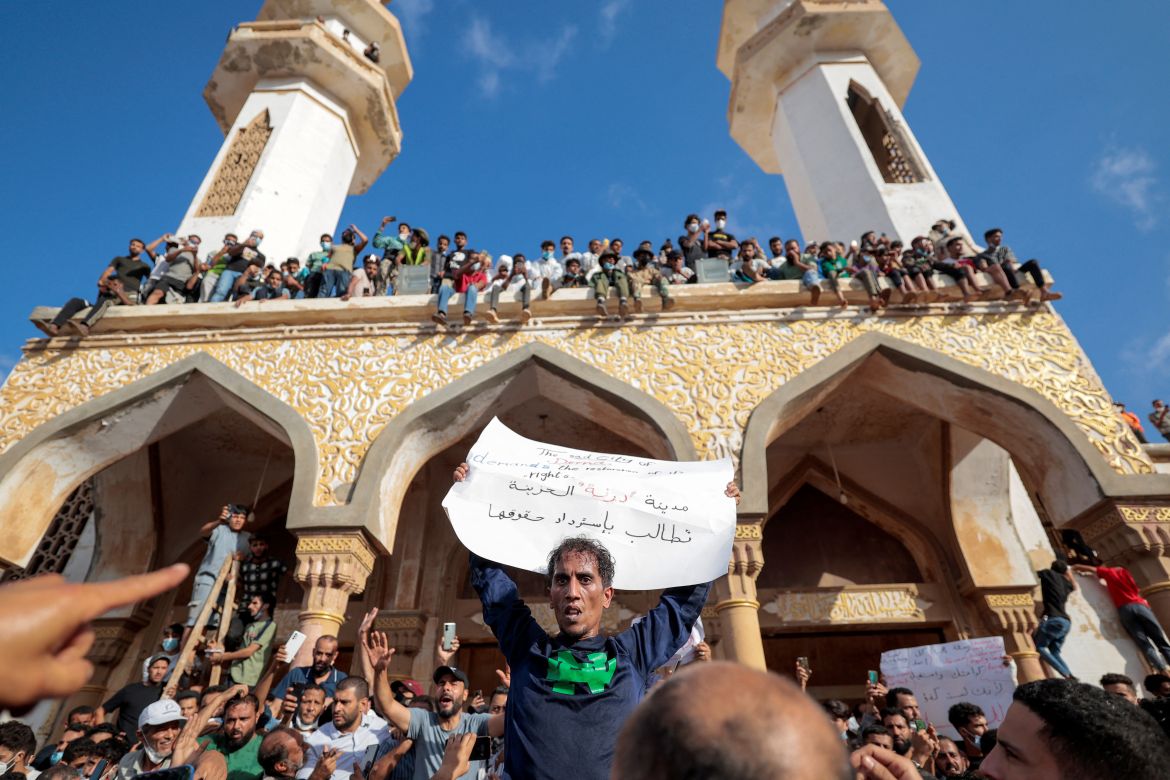
Libyan survivors protest against authorities after flood disaster in Derna
Citizens have protested in Derna, demanding accountability one week after a flood killed thousands.
People
who survived the deadly storm that hit Libya protest outside the Al
Sahaba Mosque against the government, in Derna. The sign reads: "The sad
city of Derna demands its rights". [Zohra Bensemra/Reuters]
Published On 18 Sep 202318 Sep 2023
Hundreds
of people have protested in the eastern Libyan city of Derna, venting
anger against authorities and demanding accountability one week after a
flood killed thousands of residents and destroyed entire neighbourhoods.
Protesters on Monday took aim at officials, including the head of the
eastern-based Libyan parliament, Aguila Saleh, during the demonstration
outside the city’s Al Sahaba Mosque. Some sat on its roof in front of
its golden dome, a Derna landmark.
“Aguila we don’t want you! All Libyans are brothers!” protesters
chanted, calling for national unity in a country left politically
fractured by more than a decade of conflict and chaos.
Later in the evening, angry protesters set fire to the house of the
man who was Derna mayor at the time of the flood, Abdulmenam al-Ghaithi,
his office manager told the Reuters news agency.
Hichem Abu Chkiouat, a minister in the eastern Libyan government, said Ghaithi has been suspended from his post.
5,830 views Jul 29, 2023 JERUSALEM
I never made a video in Israel's capital city Jerusalem so I figured I might as well.
If you like my content, please consider supporting my channel on Patreon, my videos keep getting demonetized as YouTube's community guidelines get stricter and stricter and it gets harder and harder for me to afford to produce content. My Patreon:
https://www.patreon.com/thesalukie
If you want to meet me in real life and/or see shorter clips from my travels, follow me on Instagram where I post updates on my location (when it's safe to do so). My Instagram:
https://www.instagram.com/thesalukie/
We speak with two Israeli journalists in Tel Aviv after lawmakers in
Israel passed a highly contested bill Monday weakening the power of the
Supreme Court by preventing it from blocking government decisions it
deems unreasonable. The bill is part of a broader set of judicial
reforms pushed by Israeli Prime Minister Benjamin Netanyahu that has
sparked months of unprecedented protests, which continued last night.
Journalist Haggai Matar says that while the Supreme Court “is not an
ally to Palestinians,” its rare rulings in favor of Palestinians are a
driving factor in the right wing’s overhaul, as well as decisions meant
to curb public corruption. Palestinian leaders have criticized both
Netanyahu’s government for pushing the judicial reform, as well as the
massive protest movement for not speaking up for Palestinian rights as
Israel continues its deadly crackdown in the West Bank. It’s time for
the U.S. to show Israel there are consequences for apartheid and
anti-democratic legislation, says Gideon Levy, columnist for Haaretz. “What kind of democracy can exist in an apartheid state?” he asks.
Date: 14 May 2022Author: lecridespeuples 0 Comments
The Debrief with Briahna Joy Gray, April 8, 2022.
Source: normanfinkelstein.com
Edition & trancript: resistancenews.org
Video
Transcript:
Question: How much of a similarity maybe do you see between the kind of… the Israeli occupation of Palestine and the way some people handle some of the reactionary and right-wing elements in the Palestinian defense and opposition, versus how some of the left is talking about the Ukraine defense and the Azov battalions… Do you think there’s a comparison? And I’ll just leave the question at that. Thanks.
Norman Finkelstein: Well I have to ask Briahna’s permission to go in a digression…
Briahna: Absolutely.
Norman Finkelstein : Okay. On the question of the Ukraine, the thing that’s troubled me about the public conversation of the Ukraine or hysteria —it’s not even a conversation, it’s hysteria about the Ukraine— is the following: those who are not totally immersed in the mainstream propaganda, some of the people you’ve had on your program and people who are not especially of the left, they have no particular left-wing allegiance, like John Mearsheimer at University of Chicago, or before he passed away Stephen F. Cohen who predicted that if you keep up with this NATO expansion in the Ukraine, there’s going to be a war. He said that in Democracy Now in 2014, and he was right. And other people, Professor Chomsky. I would include in that group several others, and they’ll all say the following thing:
Number one, the Russians were promised that there would be no NATO expansion to the East, that was the quid pro quo for the reunification of Germany after the decomposition of the Soviet Union. The Russians were promised that but the West went ahead. We’re talking about the 1990s: the promises were given, but the West then went ahead and started to expand NATO once, as John Mearsheimer likes to put it there was the first tranche, then the second tranche of expansion… Then NATO starts expanding in Georgia and in the Ukraine. The Soviet Union says it’s a red line.
To stop this, the Soviet Union offers a perfectly reasonable resolution: just neutralize Ukraine like we neutralized Austria after World War II, neither aligned with an Eastern bloc nor aligned with a Western bloc. That seemed to me perfectly reasonable. And the people I mentioned, Mearsheimer, Cohen passed away since but Professor Chomsky and a number of others, they’ll all agree on the reasonableness of Putin’s demands.
And then the reasonableness of those demands, those demands have to, as Briahna says in her paper and as she said this evening, they have to always be seen in context. So what’s the context? The context is the Soviet Union, the former Russia, it lost… the estimates are about 30 million people during World War II. The United States which, if you watch American movies, you would think the US won World War II, it lost about two hundred thousand people. The UK was the second candidate for winning World War II, they lost about four hundred thousand people. The Soviet Union lost 30 million people. Even those who didn’t take courses in the hard sciences can reckon the difference between several hundred thousand and thirty million. Now that’s not an ancient memory for the Russians. If you… I remember Stephen F. Cohen saying “when I grew up in little America —he was from Kentucky— we used to celebrate…” I forgot what was called here Victory Day, V-something, he said “but you know now as adults we don’t celebrate that anymore in the United States, Victory in World War II”, he said, but Russia, he said, they still celebrate V-Day, they still celebrate it. I live in the Coney Island section of Brooklyn. A large part is Russian Jews, a large part is Russian Jews. You go out in May, you go out on the V-Day, and you can see that Russians up to 80 and 90 year olds, they’re wearing medals, they’re medals from World War II. That memory is alive.
And now there’s this Ukraine, where Nazis are playing an outsized role. I’m not saying they’re a majority, but in the political and military life, they play an outsized —disproportionate let’s call it— role. This Ukraine where Nazis are playing an outsized role, are aligned with a formidable military bloc called NATO, NATO keeps advancing and advancing and advancing, closing on Russia, trying to suffocate it… And beginning around 2016, under Trump, begins to arm the Ukraine, pouring in weapons, engaging in military exercises with NATO, behaving very provocatively. And then the Foreign Minister Lavrov finally says we’ve reached the boiling point.
Now everything I just told you, Professor Chomsky, John Mearsheimer and others will acknowledge it. The mainstream press won’t even acknowledge that but people who call themselves just, legitimately call themselves dissidents, although Mearsheimer wouldn’t call himself a dissident, he just calls himself a realist. Nice guy, I consider him a friend, I like him. They’ll acknowledge all that. But then they say the invasion was criminal. Criminal invasion, criminal, criminal, criminal. And my question which I’ve constantly been putting in correspondence is a very simple one: if you agree that for 20 years—more than 20 years, more than two decades—, Russia has tried to engage in diplomacy; if you agree that the Russian demand to neutralize Ukraine —not occupy it, not determine its government, its form of economy, just neutralize it like Austria after World War II—, if you agree that was a legitimate demand; if you agree that the West was expanding and expanding NATO; if you agree that Ukraine de facto had become a member of NATO, weapons pouring in, engaging in military exercises in NATO; and if you agree… You know, Russia lost 30 million people during World War II because of the Nazi invasion, so there’s a legitimate concern by Russia with all of these —if you excuse my language— Nazis floating around in the Ukraine, then the simple question is: What was Russia to do?
I’m not saying I agree with the invasion, I’m not saying it went right, but I think one thing: the invasion showed… you know what the one thing the invasion showed, Briahna, was that Russia is kind of weak militarily, which is why all the more they may have been fearful of a NATO-backed Ukraine filled with Nazis, and probably at some point positioning nuclear missiles on its border. And I think 30 million, 30 million people… Listen to this: I think 30 million people is 30 million arguments in favor of Russia. Now I’m not going to say, because I’m not a general and I’m not a diplomat, so I’m not going… I’m not a military strategist so I’m not going to say it was the wisest thing to do. I’m not going to say it was the most prudent thing to do. But I will say —and I’m not afraid to say it because it would dishonor the memory of my parents if i didn’t say it—, I will say that they had the right to do it. And I’m not taking that back. They had the right to do it. They had if I can call it the historic right to do it. 30 million people (killed during WW2), and now you’re starting again, you’re starting again. No, no, you know I can’t go for it, I can’t go for those who acknowledge the legitimacy of the arguments made by Putin but then call the invasion criminal. I don’t see that.
Now you could say the way they executed it may have had criminal elements. However I don’t know… Well, you went to Harvard Law School, I don’t know if you studied the laws of war, but the laws of war make a very big distinction between ‘jus ad bellum’ and ‘jus in bello’, namely whether the launching of the war was legitimate or whether it was an act of aggression versus the way you conduct the war, ‘jus in bello’. Maybe the conduct, targeting of civilians and so forth, that probably violates the laws of war, but that’s a separate issue under law from “did they have the right to attack”. I think they did. I’m not going to back off from that.
You know, these are for me… even at my age, these are acts of deference to the suffering of my parents. My parents felt a very deep love for the Russian people, because they felt the Russian people understood war. They understood what my parents went through [in the Warsaw Ghetto & Auschwitz] during World War II, so there was a very deep affection… My father even, at the end of his life, he learned fluent Russian because neighborhood is all Russian. And you know, Polish to Russian is not a huge leap but also he liked the Russian people. So in my family growing up, the worst curse (insult)… there were two curses, two curses: curse number one was “parasite”. You have to work. My parents had a very… they had a work ethic. Believe me, I could have lived without the idea of pleasure, it didn’t exist in my house: you had to work. And the second word, the second curse, the second epithet was “traitor”. A traitor. And I know my parents would regard me as a traitor if I denounced what the Russians were doing now. How they’re doing it, as they say, probably there are violations and maybe egregious violations of the laws of war, we’ll have to wait to see the evidence, but their right to protect their homeland from this relentless juggernaut, this relentless pressing on their throats, when there was such an easy way to resolve it…
You know, if you read War and peace, and I suspect you did because you’re quite a gifted writer, obviously you were a reader…
Briahna: I confess, there was a copy on my shelf that I have started many times, but I haven’t… I’ve never finished it.
Norman Finkelstein: I’m surprised… In any case, War and peace is about the invasion of Russia, the war of 1812, and Tolstoy, the centerpiece of War and peace is the great battle of Borodino, and he describes it in this kind of terrifying detail. In the battle of Borodino, 25 000 Russians were killed, or maybe it was all together 25 000, I can’t remember, I think was 25 000 Russians were killed. Why do I mention it? So for Russians the seminal event of the 19th century was the war of 1812 and the invasion of Russia. For the 20th century, it’s World War II, and just in the battle of Leningrad, just Leningrad, not Saint-Petersburg, just Leningrad, a million Russians were killed. There was cannibalism! This is serious, World War II for the Russians. And you want me to just forget about that? That’s just a trivial fact? A trivial fact? No! Now you’ll ask yourself: in all the coverage that you’ve heard about your Russian attack on Ukraine, all the coverage you’ve read and listened to, how many times have you heard that 30 million Russians were killed during World War II? How many times?
Briahna Very infrequently. It’s never stated in this context.
Norman Finkelstein: Absolutely. And Stephen F. Cohen… You know, he was my Professor at Princeton and for a while he was my advisor. He… I didn’t know him well and at the end we had a falling down over my whole dissertation catastrophe, debacle, but Cohen had a genuine affection for the Russian people. He did. He loved the Russians. He loved the Russian people. And so when he begins his presentation… There is a Youtube of him debating the former US Ambassador, Mc Faul I think, Michael Mc Faul. How does he begin? He begins with how Russians remember the V-day. You know, that’s the starting point for me, it’s a starting point.
Now you might say well, doesn’t your whole argument then justify what Israel does because of what happened to Jews during World War II? It’s an interesting question because the most moving, the most moving speech in support of the founding of the State of Israel, by far the most moving speech, you know who it was given by at the UN? It was given by the Soviet foreign minister Gromyko. And he said it was another act of generosity. Remember I mentioned to you earlier the boy’s act of generosity where he looks past what Trichka says about Black people, and as a student I thought it was a very generous act. So now the Russians lost 30 million people in World War II, but Gromyko says the suffering of the Jews, it was different, it was horrible. Here is a Russian saying that. And he said if a binational State is not possible, they earned their right to a State. So I say I applied the same standard. Now the way Israel carried out its right to establish a State by expelling the indigenous population, appropriating their land and creating havoc and misery for generation after generation, decade after decade, no I’m not going there. But yes I do believe… in recent correspondence with some friends I use the expression “I think Russia has the historic right to protect itself”, not by violating somebody else’s right to self-determination but neutralization, I think that’s legitimate.
Briahna: So I want to ask you this because you know it wouldn’t be right for me to put this question to Ro Khanna and not put this question to you. You are speaking so compellingly about the kind of moral valences of who’s entitled to feeling insecure as a nation, who’s entitled because of the historical cost it has paid to defend itself and to defend whatever you want to call it, you know, democracy in fascism, all of these kinds of words, has paid in terms of the number of human lives and kind of an unmatched price, and I think that’s…
Norman Finkelstein: The Chinese lost about 26 million to the Japanese, so it was close.
Briahna: It’s close but still… And yet when I was talking to Ro Khanna and he was saying well, ultimately he’s arguing on the other side that America is 100% right, Russia’s 100% wrong and this is a just war regardless of the substance. I would push him on this idea, of even if you believe it to be just kind of morally, the act I’m going to have to as a leftist is pushback against the idea that the preemptiveness of the war is okay, and that war is a solution. It is something that we should be tacitly or implicitly condoning. And I wonder what you make of that question.
Norman Finkelstein: Look, Briahna, not to flatter you but you always ask the right questions, and that’s why I was careful in what I said. You referred to the pre-emptiveness. Russia tried for 22 years. That’s giving a lot of time to diplomacy! 22 years is a lot of time!
And the question is: at what point, at what point does Russia get to act? When there are nuclear-tipped missiles on its border? Is that when it gets to act? I don’t agree with that. I think of course you have to give maximum time to see if diplomacy is going to work, absolutely…
Briahna: And then you start fighting? And then you send in troops? Because Norm, this is the… whether or not you believe…
Norman Finkelstein: I’m very happy, I’m very happy to take to heart your question. And that leads me again with the same question that I returned to you and I’ve returned to all of my correspondents over the past six weeks. If it’s clear that all the negotiations are in bad faith, if it’s clear that Ukraine had become de facto a member of NATO, what was Russia supposed to do? You say “don’t send in troops”. Fine. I come from a family that was completely anti-war. My mother used to say “better a hundred years of evolution than one year of revolution”. She had enough of war. I have no problem with your recoiling at the process. But what I’m saying is what was Russia supposed to do?
Briahna: What I’m asking is how you distinguish between your feelings that this is a moral war, this is a justified act, fine, and someone like Ro Khanna’s belief that US intervention, continued support of NATO, Western powers, sending weapons into Ukraine, arming the Azov battalion, is as he puts it a just war. The fact that you are both making these arguments, regardless… I’m not making an equivalent between the value of your arguments but obviously Ro Khanna thinks what he thinks and my point to him was you using vague terms like “just war” is exactly what’s allowed the kind of jingoistic parade to lead us into so many other incursions. So how principally do you distinguish? I understand your feeling and I understand the historical citations and the loss of life that leads you to the conclusions that you’ve been led to, but someone on the other side will say the same thing, someone else said “Well Marshall well this is how many Ukrainians have suffered and this is…”
Norman Finkelstein: But you’re canceling, if I may use that word, you’re canceling the context. You see I began my whole discussion with you, not with the position of Biden or the position of lunatics like Judy Woodruff, you know, and PBS. I said my quarrel is with people on the left who agree with all of my context but then make the leap and say it’s a criminal invasion. And I say to Professor Meirsheimer, Professor Chomsky and many others who acknowledge everything I just said, I say then what was… if you agree with everything I said, what was Putin supposed to do? I don’t see what he was supposed to do. I’m lost. It’s an impasse. I don’t see what…
Briahna: You were making a reference earlier to laws of war and rules before, i don’t know about it, I’ve never studied the laws of war, but it does seem to me that a line is drawn between… and I know that people are going to say something can be constructively war and you know. But in terms of an actual invasion and boots on the ground or missile strikes or things like that, the thing that Russia has to do even if it disadvantages them strategically in some ways is to wait until the other person hits first.
Norman Finkelstein: I don’t agree with that. I would say, as in any case, you have to demonstrate its last resort, and therefore you do have to demonstrate…
Briahna: How do you do that? Because that’s the question, how do you make sure that this is not just the same kind of…
Norman Finkelstein: I’m going to give you a historical analogy, probably the details which you’re unfamiliar with, but just allow me to just sketch it out. So in 1967, Israel launches a war, it occupies the West Bank, Gaza, Syrian Golan heights, and then it occupies this huge area, the Egyptian Sinai. And after the 67 war, about three years later, when Anwar Sadat comes into power, he says “I’m willing to sign a peace treaty with Israel but they have to return the territory they acquired during the 67 war”, because that’s the law : under international law, it’s inadmissible to acquire territory by war. Israel acquired the territory during the june 67 war, so these territories belong to Egypt. Israel says no, we’re not leaving the Sinai. Sadat says “Look, I’m offering you a peace treaty, I’m offering you peace, just return what’s not yours, the Egyptian Sinai”. Israel says no. Then Israel starts creating facts in the ground in the Sinai, it starts building settlements, those same settlements you’re familiar with in the West Bank. And then it announces in 1972 it’s going to rebuild what’s called the old jewish city of Carmel. Egypt says you’re not going to do that. You’re crossing a red line. Egypt says if you don’t stop this we’re going to attack, we’re going to attack. Everybody ignores Egypt because Arabs don’t know how to fight wars. The Arabs were nicknamed after 67, the term of abuse for an Arab was they were “monkeys”, they called them monkeys. They don’t know how to fight wars. Okay? And then come october 1973. Guess what: Sadat attacks. And the Israelis were so shocked they thought the whole thing was over, they called it… Moshe Dayan who was the Defense minister at the time, or the Foreign minister I can’t remember which, I think Defense minister at the time, he says… he made this panicky phone call, he said it’s the end of the third temple. This is it, we’re finished. Well it wasn’t the end of the third temple but it was a significant, heavy loss to Israel, they lost between two and three thousand soldiers, which is the largest number except for the war in 1948.
Now here’s the point: the point is no country in the world, none, including the United States, no country in the world condemned Sadat for aggression, none. And you know, for Israel it was a close call, or it seemed to be. In retrospect it turned out not to me, but it seemed to be a close call. Nobody condemned Egypt. Why? One, its demand was legitimate. Return the Sinai, it’s not yours, it’s our territory. Number two: Sadat tried negotiations for six years. And number three, as hard as he tried to negotiate, Israelis kept provoking and provoking and provoking until they announced rebuilding the old jewish city of Carmel. And Sadat says it’s over and then plans with Syria the attack which happens, what’s called the Yom Kippur war, the october war in 1973.
So now fast forward to Putin: the man was reasonable (neutralize Ukraine), negotiates over 20 years to fighting over this NATO expansion in the East, and then they start provoking them even more, they start pouring weapons into the Ukraine, they start carrying on joint military exercises between Ukraine and NATO. And then all of these swarmy Nazis start to surface. No I’m not saying Nazis control the government but they play an outsized role in the government, in the military. And I don’t see what’s the difference between what Putin did and what Sadat did. I don’t see the difference. I think it was the same thing, and nobody condemns Sadat for aggression. No one.
File:Azov Battalion and SS Emblems And Symbols.jpg - Wikimedia Commons
Briahna: But I’m asking I think a different question. I’m really not interested in litigating any given case mostly because I don’t know what the hell any of these things are about, so like I don’t really… I’m not going to say whether this war is just, that’s for other people to determine. What I do know is that everyone is making that argument on all kinds of sides, including people I know I don’t disagree with. And so many wars have been started with the argument that it is a just war for x, y and z reasons, and it’s okay to act despite there not having been a direct act of aggression against the allegedly aggrieved party. And so all I’m asking is to give some thought to how one would articulate a standard that can’t be so easily abused.
Norman Finkelstein: You know, Rihanna, I agree, it’s like once you grow up in life, you discover that life is very little about principles: it’s mostly about judgment. Principles get you not very far. I remember I got this lesson from Professor Chomsky, as he always puts it in his very lucid, simple terms. He said to me once: “Norman, we all know it’s wrong to lie, but if a rapist knocks in your door and asks “Is your daughter in the bedroom”, there’s a clash of principles there obviously. And so at the end of the day, what is required is not the application of an abstract principle but the faculty of judgment. When principles clash, you have to exercise judgment. You then have to look at particulars, the specifics.
Briahna: Excuse me, I appreciate that, which is probably why, you know, this is the limit, this is the limit of it for me and I’ll… I’m happy to take more questions from people who I’m sure know much more about the particulars. Although your last statement about, you know, principles versus judgment, and you know, the rapist at your door, does make me, it does make me tempted to ask you about what you think about the slap. […]
[If you want to know what Norman Finkelstein thinks about Will Smith’s slap at the Oscars, and other more serious issues, check the full podcast].
es
Live updates,
Jenin attack live: Palestinian deaths in Israeli raid rises to 11
JENIN, PALESTINE - 2023/07/04: Palestinians inspect shops burnt and destroyed by Israeli forces in the middle of the Jenin refugee camp, during the storming of the camp near the city of Jenin, in the northern occupied West Bank. Palestinian health officials said at least 10 Palestinians were killed in Israeli raids and airstrikes. Army spokesman Rear Adm. Daniel Hagari said Israel launched the operation because some 50 attacks over the past year had emanated from Jenin. (Photo by Nasser Ishtayeh/SOPA Images/LightRocket via Getty Images)
Al Jazeera English
CA
4:03 / 47:17
Palestine 1920: The Other Side of the Palestinian Story | Al Jazeera World Documentary
Al Jazeera English
12.6M subscribers
Al Jazeera is funded in whole or in part by the Qatari government. Wikipedia
4,042,804 views 2 Feb 2022 #Palestine #Documentary #History
“A land without a people, and a people without a land” is how the relationship between Palestine and the Jewish people was described by Christian writers in the 1800s. And the 20th-century history of the Middle East has largely been written through these eyes.
But this film from Al Jazeera Arabic looks at Palestine from a different angle.
It hears from historians and witness accounts, and features archive documents that show Palestine as a thriving province of Greater Syria and the Ottoman Empire at the dawn of the 20th century.
The evidence suggests that its cities had a developing trade and commercial sector, growing infrastructure, and embryonic culture that would enable it to meet the challenges of the decades ahead.
However, the political ramifications of the Balfour Declaration, San Remo
Conference and British Mandate set in motion a series of events that profoundly affected this vibrant, fledgeling society and led to the events of 1948 and beyond.
This film is the other side of the Palestinian story.
Connect with Al Jazeera World:
‣ YouTube: https://aje.me/AJWplaylist
‣ Twitter: / aljazeeraworld
‣ Facebook: / aljazeeraworld
‣ Instagram: / _aljazeeraworld
‣ Website: https://www.aljazeera.com/program/al-...
#Documentary #Palestine #History
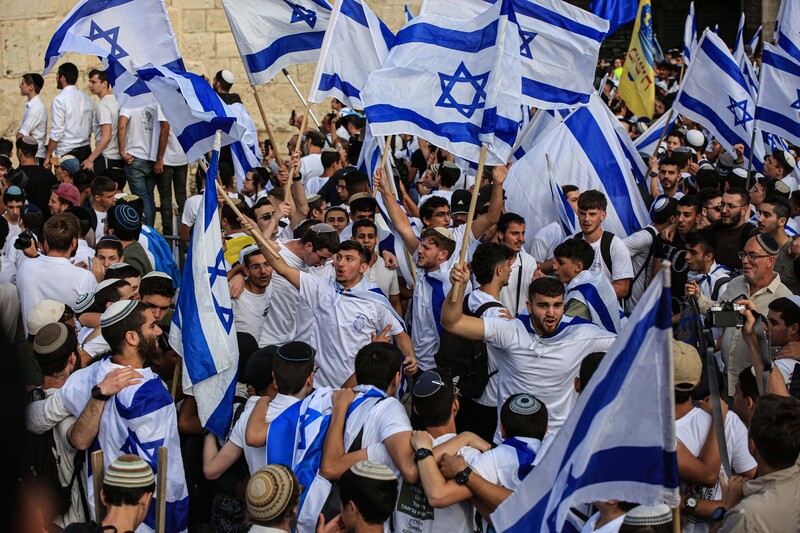
Religious ultranationalists rally outside of the Damascus Gate to Jerusalem’s Old City on 18 May.
Saeed QaqSOPA Images
Israel’s annual “Death to the Arabs” religious nationalist spectacle in Jerusalem’s Old City on Thursday featured harassment and assaults against Palestinians and journalists by both participants and police.
Marchers chanted genocidal slogans such as “we will burn your village” and “I will avenge one of my two eyes from Palestine, may their name be erased.”
charming. heard this one all day. was more popular than "death to arabs" tbh.
"and I will avenge one of my two eyes, I will avenge one of my two eyes from Palestine, may they name be wiped"
Officially billed as a Jerusalem Day flag rally, the event purports to celebrate Israel’s acquisition of the eastern sector of Jerusalem by force following the 1967 War and its subsequent occupation and illegal annexation.
Palestinians are forced to shut down their shops and their movement is restricted to make way for marchers who in recent years have come to be known for their racist anti-Palestinian chants as they seek to assert Jewish dominance over the entirety of the city.
All shops in Damascus Gate ordered shut by the occupation forces (told to stay closed after 2pm) and also by intimidation the marching youth who shout "shut your door" at shopkeepers with an open crack. pic.twitter.com/z2RNGMvcE1
This year the march came days after a ceasefire that ended a five-day Israeli surprise attack on Gaza that left 33 Palestinians dead in the coastal enclave.
During the escalation, an Israeli woman and Palestinian laborer from Gaza were killed by rockets fired from the territory in response to a series of assassinations of prominent figures belonging to the Islamic Jihad resistance faction.
Israel went ahead with the Jerusalem event despite its cancellation being one of Islamic Jihad’s initial ceasefire conditions. Prime Minister Benjamin Netanyahu doubled down on the march and its provocative route through the Muslim Quarter of the Old City, despite pressure from the Biden administration to change the route, lest he appear to compromise with the Palestinian resistance.
The march threatened to further destabilize an already fragile situation.
The flag march was a catalyst for the May 2021 war in Gaza that left more than 250 Palestinians dead in the besieged territory and 12 people dead in Israel.
While this year the event passed without a dramatic escalation, Palestinians endured ramped-up racist violence that is a daily reality in the city.
The scene right now: marching settlers spit at Palestinians. Soldiers intervene and then beat up Palestinians. Then settlers ask soldiers to beat the Palestinians who hadn't got beaten, then soldiers follow the orders of the settlers, and beat those who got pointed at . pic.twitter.com/uaVjB6GTCp
According to the Tel Aviv daily Haaretz, “before the march reached Jerusalem’s Old City, clashes erupted between Jewish marchers and Palestinian residents.”
The paper added that “in one incident, verbal insults hurled by Jewish participants turned into pushing and physical assault against the Palestinians. One resident was knocked to the ground and briefly beaten; law enforcement intervened and dispersed the Palestinians involved.”
Marchers also attacked journalists, including a correspondent for Haaretz. Police also assaulted journalists, including a Haaretz photographer and CNN correspondent Ben Wedeman.
The BBC’s Middle East correspondent Tom Bateman described journalists being hit with projectiles at Damascus Gate:
Ahead of Israeli extremists’ incursion at al-Aqsa, Palestinian community leader Fakhri Abu Diab was assaulted by police at the holy site while giving a live telephone interview with Israel’s Ynet news:
Police threw Abu Diab’s phone to the ground, breaking it, and forced him out of the al-Aqsa mosque compound and ordered him to not return to the Old City, The Guardian newspaper reported.
Media coverage: “Israeli military forces forcibly expel Palestinian researcher Fakhri Abu Diab from Jerusalem’s Al-Aqsa Mosque to secure settlers’ incursion into the holly site.” pic.twitter.com/T5GsyKdkLA
Haaretz noted that during the rally and march, “hundreds were filmed shouting ‘death to Arabs’ and ‘a Jew is a soul, an Arab is the son of a whore’ near the Damascus Gate” – the eastern entrance to the Muslim Quarter of the Old City and a center of Palestinian cultural and social life.
Several Israeli lawmakers and some cabinet ministers participated in the march this year, including extremist finance minister Bezalel Smotrich:
And, Bezalal Smotrich was there... [did he bring some of his children?] https://t.co/4PGwUtLt7w
Ukrainian-born Yuli Edelstein, a lawmaker belonging to Netanyahu’s Likud party, was there as well:
الإعلام العبري: "ما يسمى رئيس لجنة الخارجية والأمن في "الكنيست" يولي إدلشتاين يشارك في "مسيرة الأعلام التهويدية" بالقدس المحتلة". pic.twitter.com/4D6FVjp6wg
— القسطل الاخباري | القدس (@AlQastalps) May 18, 2023
Yizhak Kroizer, a lawmaker belonging to public security minister Itamar Ben-Gvir’s Jewish Power party, said that the event is about “applying sovereignty to all parts of Jerusalem.”
Ben-Gvir, who holds authority over Israel’s police, arrived at Damascus Gate with a police escort to participate in the march.
ما يسمى وزير أمن الاحتلال "إيتمار بن غفير" يصل للمشاركة في "مسيرة الأعلام" في باب العامود بالقدس المحتلة pic.twitter.com/4SbHNeYwYq
— القسطل الاخباري | القدس (@AlQastalps) May 18, 2023
“It’s amazing here.” - Kahanist Minister Ben Gvir arriving at the Jerusalem Flag March where settler youth openly taunt, punch, spit on, and verbally and physically abuse Palestinians (as they are protected by police) on their way to the Western Wall. https://t.co/6HwM6uDLtd
CNN reported that “some of the marchers chanted: ‘Who is here? The prime minister is here,’ suggesting that they think Ben-Gvir, not Prime Minister Benjamin Netanyahu, controls Israel’s government.”
Israel Katz, the energy minister who belongs to Netanyahu’s Likud Party, used the occasion to threaten Yahya Sinwar, the leader of Hamas in Gaza, with assassination.
Earlier in the day, The Times of Israel reported, lawmakers from Likud and Jewish Power made a provocative tour of the al-Aqsa mosque complex with around 1,200 Jews. Some openly prayed in violation of the status quo arrangements at the holy site.
Insecurity
The violent spectacle reveals both the insecurity of the Zionist project in Palestine and the racist violence that is at its core.
Not to rain on your settler parade, but if you need thousands of soldiers and secret service agents suppressing every aspect of life in the city so you can march with your fascist flags, it is not your city. You are occupiers. pic.twitter.com/yEgX5yo40r
Israel’s policy towards Palestinians in Jerusalem is in pursuit of demographic engineering to ensure a Jewish majority in the city, using all the tools at its disposal: settlement-building, forcing Palestinians from their homes, revoking Palestinian residency rights, home demolitions and so on.
The al-Aqsa mosque compound, and its centrality to Palestinian identity, is a primary focus of Israeli extremists who seek absolute Jewish domination from the Jordan River to the Mediterranean Sea.
Temple movement activists ultimately seek the destruction of the Dome of the Rock, also housed in the mosque compound, and the construction of a Jewish temple in its place.
Israel’s antiquities authority recently released a rendering of a future Jewish temple at the site of al-Aqsa as part of a promotion of biblical tourism.
Colleagues at @EmekShaveh expose this illustration from #Isarel's Antiquities Authority, rendering the *future* Jewish temple (complete with cars and buses transporting worshipers) on al-Ḥaram al-Sharīf #Jerusalem. Beyond the acquisitive role played by Israeli authorities in… https://t.co/I3oieLZxqs
The Israeli-controlled Jerusalem municipality, in partnership with other government entities and and the settler group Elad, have advanced the demolition of Palestinian homes in Silwan, a neighborhood near Jerusalem’s Old City, to establish a theme park named after the biblical King David.
🧵Thread.
Settler take-over of our lands in Wadi Al-Rababa, Silwan. The takeover is led mainly by the Elad Settler Organisation (also known as City of David) and the so-called Israeli "Nature Authority", a front for settlers in occupied Jerusalem.
Who was involved in the takeover of our lands in Wadi Al-Rababa? A wide array of Israeli institutions. Here is a list of nearly 10 institutions, underlined: pic.twitter.com/L61UgMdFvX
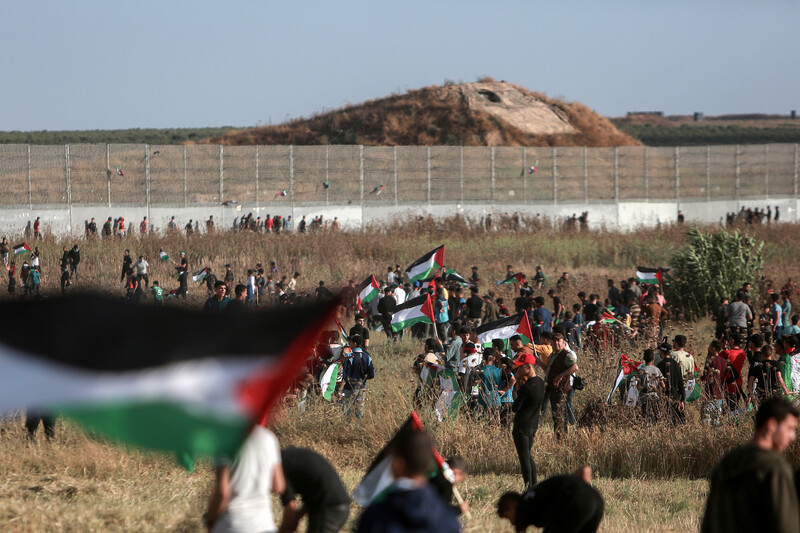
Even if there wasn’t a response from the resistance in Gaza, where protests were held along the boundary with Israel on Thursday, the Jerusalem Day march and the extremist movement it represents may still provoke one.
Palestinians protest Israel’s annual Jerusalem Day flag march east of Gaza City along the boundary fence with Israel, 18 May.
Mohammed DahmanAPA images
Basim Naim, Hamas’ head of political and foreign relations, told Al Jazeera before this year’s Jerusalem Day rally that increasing power in the hands of Israel’s extreme right has led to dangerous developments such as the storming of the Old City’s Muslim Quarter and attempts to march through al-Aqsa.
“Hamas is not eager to escalate. But if it is about Jerusalem, about al-Aqsa, about [the] central pillar of the Palestinian cause … we are ready to go to the end … to sacrifice all we can,” Naim added.
Naim accused the current Israeli government of “taking the whole conflict into a religious corner” that may spill over “in other countries.”
“It is not a conflict between Gaza and Israel – it is a conflict between Palestinians everywhere and Israel,” Naim said. “And if it is about the holy places, it means that you are recruiting millions and millions of Muslims to the same conflict.”
A conversion of “a political conflict into a religious one,” Naim said, would be “very difficult, if not impossible, to solve.”






Add new comment