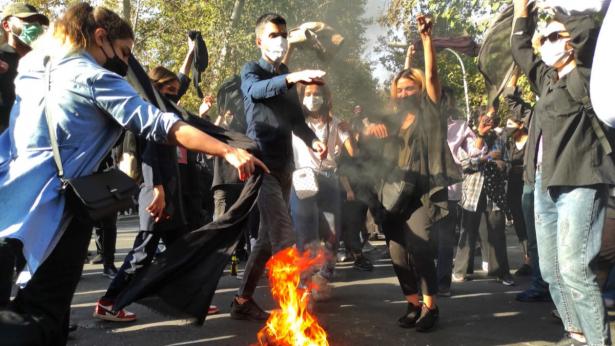
Anti-government protests in Iran, launched in September following the death of Iranian Kurdish woman Mahsa Amini in the custody of Iran’s morality police, have passed their 100th day, even as demonstrators have been met with widespread arrests, brutal violence by police and executions. The Human Rights Activists News Agency reports thousands of protesters have been arrested and more than 500 protesters have been killed so far, including 69 children. At least 26 more demonstrators are facing execution. As calls grow for the United States and the international community to respond to Iran’s brutal crackdown, President Biden has hinted attempts to restore the Iran nuclear deal may be dead. We’re joined by Hadi Ghaemi, executive director and founder of the Center for Human Rights in Iran, and Nahid Siamdoust, a former journalist who is now Middle East and media studies professor at the University of Texas at Austin.
Transcript
This is a rush transcript. Copy may not be in its final form.
AMY GOODMAN: We begin today’s show looking at the ongoing anti-government protests in Iran, which passed their 100th day this week. The protests have been met with widespread arrests, brutal police violence and public executions. This week Iranian authorities targeted the family of the Iranian soccer superstar Ali Daei, who has for months been an outspoken critic of Iran’s crackdown, by, quote, “forcing an Iranian airliner to land mid-flight” so his wife and daughter could be removed from the plane and stopped from leaving Iran. The Human Rights Activists News Agency reports thousands of protesters have been arrested and more than 500 have been killed so far, including 69 children. This follows the recent public executions of two young men for their participation in protests. The Oslo-based organization Iran Human Rights has identified at least 100 detainees sentenced to death or charged with capital offenses.
The protests began in September under the slogan “Woman, life, freedom,” following the death of the 22-year-old Iranian Kurdish woman Mahsa Amini in the custody of Iran’s so-called morality police, after she was detained for what they called inappropriate attire.
As calls grow for the United States and the international community to respond to Iran’s brutal crackdown, President Biden has hinted attempts to restore the Iran nuclear deal may be dead.
For more, we’re joined by two guests. Hadi Ghaemi is the executive director and founder of the Center for Human Rights in Iran, which recently issued a series of recommendations on how Congress can play a vital role in supporting the protesters in Iran. And Nahid Siamdoust is a former journalist who’s reported across the Middle East, including in Iran, and is now Middle East and media studies professor at the University of Texas at Austin.
We welcome you both back to Democracy Now! Thank you so much for joining us. Let’s begin with Professor Siamdoust in Austin. Can you talk about the significance of these protests and why, unlike previous ones which were extremely serious across Iran, these have lasted so long, and if you expect them to continue and grow, Professor Siamdoust?
NAHID SIAMDOUST: Sure. Thank you for having me, Amy.
These protests have been ongoing because they’re not a single-issue protest. So, they were caused by the death of Mahsa Zhina Amini, but they have been sort of brewing for many, many years and decades, and they’re rooted both in a corrupt state, a state with impunity, who, as we know, you know, with the protesters whom it has put on the death row, assigns them lawyers who, in part, will even speak against their own clients — and the impunity, the lack of justice, the fact that the Islamic Republic has been imposing a kind of lifestyle on Iranians at large, that people, especially the young ones, who have been on the streets, completely reject.
So, these protests are ongoing because — also because Iranians for several decades played along with this, you know, pretense of the Islamic Republic that the system could be reformed from within through various processes such as elections. And so there’s now been a reckoning, a nationwide reckoning, that that is no longer a possibility, that that will not be happening. The most recent elections of Ebrahim Raisi, of course, were the most engineered, where Iranians showed up in the sort of lowest numbers ever in the postrevolutionary history.
And so, it’s really a point at which many of these strands are coming together, and there’s a reckoning that this system is no longer a system that people at large want to maintain. And, you know, the deep cultural roots of it are visible in all the artistic productions that are going on, in all the creativity that’s there in the slogans.
NERMEEN SHAIKH: Nahid, could you comment, in fact, precisely on why it is that so many figures from the Iranian cultural world have been targeted, from film directors, award-winning film directors, actors, musicians? If you could explain what the significance of that is? And this phenomenon seems to be spreading.
NAHID SIAMDOUST: Sure. Precisely because of the process that the Islamic Republic has pursued over the last few decades, which has shut down any kind of political, internal, organized opposition to it or alternatives to it, celebrities and filmmakers and musicians have, because of that crisis of representation, really become the spokespeople of the people. And so, they are the ones who have the kind of following on social media that allows them to speak for the people and to represent them. And that is precisely why also the state has been targeting them.
You know, some of the most powerful videos that we’ve seen or statements that we’ve seen recently have come either from rappers — Toomaj Salehi, who is also sitting on death row right now — and
Mani Haghighi, the filmmaker, who spoke out very strongly against the minister of culture, who asked filmmakers and musicians and artists to come out again into the fray and produce their work, to which Mani Haghighi said, “I’m sorry, but we’re too busy mourning the people you’re killing to come out and dance for you.”
NERMEEN SHAIKH: Hadi Ghaemi, could you comment on the enduring protests? And your organization has been documenting human rights abuses. Could you explain what those abuses are, Hadi Ghaemi?
HADI GHAEMI: Yeah. Good morning. And thank you for having me.
The human right violations are very widespread. They’re happening all over the country. And if you just look at the numbers, they speak very loudly. We have had over 500 people killed, and that is a minimum. I really believe it’s twice that, because I’m aware of many families who have been forced to not publicize the death of their children on the streets or family members. So, over 500, possibly 1,000, people are dead on the streets. Nearly 20,000 people have been taken into prison, and at least over 10,000 of them remain as political prisoners. We have 69 children, people under the age of 18, killed on the streets, and many more detained and taken to unknown locations.
So, to basically sum it up, with the executions happening right now, we are seeing very widespread growth and serious violations, and most serious one also includes sexual assault. We’re starting to get reports of rape of young girls and women in prisons, and sexual assault from the time they are picked up in the street 'til they're taken to interrogations and during the interrogations, and even death in custody as the result of very severe sexual assault. So, unfortunately, the situation in Iran in terms of human rights metrics is a complete disaster and is the worst I have ever seen it with my own eyes.
AMY GOODMAN: And, Hadi Ghaemi, talk about what women face, the sexual abuse. Nicholas Kristof wrote a piece —
HADI GHAEMI: Yes.
AMY GOODMAN: — in The New York Times recently, “Iran Uses Rape to Enforce Women’s Modesty,” quoting — well, talking
about a 14-year-old girl. Explain what happened.
HADI GHAEMI: Indeed, it’s a very heartbreaking story, and it came to us from very much on the ground, from people who were engaged and witness to every stage of it. This was a 14-year-old girl living in a
neighborhood that, ironically, is populated by many people who work for the regime as security forces, actually for its special forces on the streets and their armed men on the street. Many of them, we were told, live in that neighborhood. And yet, the high school, the girls’ high school in that neighborhood, became a hub of protest and activity in late September, early October. And Masooumeh, the 14-year-old girl, had joined the protest in her school. The school cameras identified her. She was picked up, taken away for three days.
And when she came back after three days, she was completely mentally and physically
destroyed. She had suffered serious sexual assault, including gang rape and violence, and had serious injuries to her body as a result and psychologically had completely lost it, and going around her apartment complex and telling everyone what had happened to her.
Her mother decided to publicize this and was in the process of documenting it and bringing it out to the open. But given the neighborhood,
a security force who lived in the building and was actually a friend of the mother, became aware and alerted the authorities, who came again that night and took both the mother and daughter away.
After a few days, the neighbors had to pool together all their resources to go and post bail, a very heavy bail, for the mother. And the daughter’s body was turned to them
in a mental hospital, in a psychiatric hospital. She had died. They had taken there. We don’t know what happened then, but her body was turned in. Again, our sources were involved in burying her. And then, the mother was so frightened, she took her other child and disappeared.
So, we’re very confident this happened, and we’re worried many more have happened.
It’s starting to seep out from inside prisons and other families. We’re encouraging families to preserve the evidence, the medical
evidence especially, 'til they're safe and secure to publicize it.
NERMEEN SHAIKH: Professor Siamdoust, if you could also comment on this phenomenon, the truth of which is only just coming out, the sexual violence against protesters, and also the way in which the protesters are taking on new methods? There is now a lot of video circulating with turban tossing, protesters going after clerics and tipping over their turbans before running away. Professor Siamdoust?
NAHID SIAMDOUST: Yes. You know, these protests have been fought on many, many fronts. And we have had, as Hadi Ghaemi just mentioned, these horrible, horrible reports of torture, of sexual abuse coming out from the prisons. And, you know, the tipping off the turbans, that one of the youths who had done that and who had been imprisoned for that and released from prison, three days after his release, committed suicide. So, you know, we know, based on both these reports, but also the number of people who — very young people who come out of — you know, the person who committed suicide was 16 — the young people who come out of prison and are no longer themselves or commit suicide, that clearly horrible things are happening once these children and adults are arrested and taken in.
AMY GOODMAN: Axios has a new report on President Biden
saying, in newly surfaced video, that the Iran nuclear deal is dead. Axios reports Biden made the remark in a short conversation with a woman who attended an election rally in
Oceanside, California. The woman asked Biden to announce that the JCPOA, the Joint Comprehensive Plan of Action, as the Iran deal is formally known, is dead. Biden responded he would not, for a lot of reasons, but then added, “It’s dead, but we’re not going to
announce it.” You can listen closely.
SUDI FAROKHNIA: President Biden, could you please announce that JCPOA is dead? Can you just announce that?
PRESIDENT JOE BIDEN: No.
SUDI FAROKHNIA: No? Why not?
PRESIDENT JOE BIDEN: No. A lot of
reasons. It is dead, but we’re not going to announce it.
AMY GOODMAN: Hadi Ghaemi, if you can talk about the significance of this happening now with the —
HADI GHAEMI: Yeah.
AMY GOODMAN: — protests taking place? You are a former CUNY professor of physics, as well.
HADI GHAEMI: Yes. Yeah, so, look, before these protests, the JCPOA
negotiations were going nowhere. The Iranian government had missed a lot of opportunities to come back to the deal, and it was throwing a lot of obstacles in the path of it. Then these
protests happened, and the situation is completely different.
Let me tell you what I hear from inside Iran. The Iranian people, at least the ones I talk to, and the analysts are saying that,
“Look, we are a party to this deal, too.” Especially the economic benefits that would flow to the regime at this moment is absolutely not justified, and let alone the fact that there can be no trust that they will follow up with their nuclear commitments if they sign a new deal. So, they’re saying that, for example, the blocked money in the banks that could come back to the
Iranian government is really belonging to the Iranian people. It is the oil sales proceeds, and the Iranian people have no role in these negotiations, and their interests should be protected. So, they are especially pointing out that it shouldn’t — any economic benefit should only be
tied not just to the nuclear activity, but to the crimes being committed. They want a moratorium on executions. They want a release of all political prisoners. They want the
freedom to assemble as their Constitution guarantees.
So, the situation has changed a lot, but the Iranian government is sending a lot of signals that it is willing to come back to
negotiations, because it obviously wants the economic benefits that will beef up its repressive machinery, which is under a lot of stress. But I hope President Biden really meant it, and especially Europe and U.S. are not trying to strike a backroom deal of thinking this
way they can put the nuclear issue in check. I think it would be a disaster to move forward
with the old deal. We really need to construct a new package that represents the interests of
Iranian people, who are not at the table.
NERMEEN SHAIKH: Hadi, can you explain what the punitive measures now in place, the sanctions against Iran, what effects those are having, whether they have been in any sense weakening the regime or the economy? And if so, in
what ways?
HADI GHAEMI: Well, the new sanctions, not really. They’re targeted against the individual and institutions mostly involved in human right violations or carrying out the violence. None of these people really have assets or activity abroad that we can know that is substantial. But
it is a minimum that should have been done.
I think a lot more has to be done to send a strong message to Iran. The U.S. does not have diplomatic relations, so it somewhat doesn’t have many tools in its toolbox. But Europe does. EU, we have been recommending, should
be pulling its ambassadors in tandem, in protest. And this doesn’t mean — they argue that we need diplomatic representation, and it’s more important to have eyes on the ground. And
I agree with them. We’re not saying to sever all diplomatic relations. But the ambassadors are mostly doing a symbolic role inside Iran. They’re not needed. And it would be much
more impactful.
And then, the Security Council has obligated
itself, since 2017, to have a session and attention to instances of sexual violence in conflict. And this usually happens in February, March. So, I believe the Security Council should take that up.
And, of course, Iran’s work with Russia and the support it’s getting from Russia and China makes it much more essential for international community to come up with solutions to address the crisis, which also involves Iran’s destructive role in the Ukraine war.
So, I
think the international community, especially U.S., Europe, Japan, like-minded countries, and Global South, should be coming together and exerting much more diplomatic, political
isolation of the Iranian government, given the way it has behaved. And only then the Iranian people will feel like the international community is doing something substantial.
AMY
GOODMAN: Let me put this question to Professor Siamdoust. Do you feel the same way as
Hadi Ghaemi around the issue of the nuclear deal? And also, the significance of Israel’s new government, the most far-right government in its history, now coming into power, with Benjamin Netanyahu appointing his longtime political ally Tzachi Hanegbi as head of the National Security Council? He is known as the hawk on Iran.
NAHID SIAMDOUST: Yeah, that’s right. Yes, I think Iranians, at large, and the activists on the ground, for sure, they are seeking the solidarity of the international community, and especially its leaders. They are not looking for the international community and these foreign governments to make new deals
with the Islamic Republic. They are asking for them to really highlight, you know, the
executions that are going on, the repression that is going on, and not to make deals with a state that is repressing and killing its own people. That has been the demand of the protesters.
As far as Israel is concerned, and its new national security head, who recently
commented that its pilots should get ready because in two or three years’ time, they might be
bombing Iran, certainly, the geopolitical situation in the region is volatile, and not having a deal with Iran and Iran being able to develop its nuclear energy, of course, has always raised concerns about nuclear arms, even though Iran does say that it is not pursuing them. And so,
it’s a volatile situation that Western governments and other foreign governments are trying to balance. But that has to be — you know, that has to be balanced against the kinds of demands that foreign governments will make of the state in Iran, and fundamental things have to change before any talk of that could proceed. And many protesters and most protesters and activists would say that they are not looking for that. They are not looking for a deal with the Islamic Republic, because they are trying to unseat the Islamic Republic.
NERMEEN SHAIKH: And, Nahid, could you explain, just before we end, whether there are any governments, in Europe or elsewhere, that have been taking measures in solidarity with the protesters in Iran?
NAHID SIAMDOUST: I mean, most recently, the foreign minister of Germany has said that they will not be entering nuclear negotiations with Iran. She has stated — the spokesperson for the minister has stated that Germany is on the side of the protesters, and their focus and their attention is toward the repression that is ongoing and to the people’s fight for freedom
and justice, and that they are not interested in starting negotiations. So, that was really circulated on social media. It was embraced by Iranian activists and Iranians at large. And
that is kind of the approach that Iranians are looking for.
AMY GOODMAN: We want to thank you both for being with us. Nahid Siamdoust is Middle East and media studies professor at University of Texas, Austin, former journalist
—
NAHID SIAMDOUST: Thank you.
AMY GOODMAN: — who’s reported across the Middle East, including in Iran. And Hadi Ghaemi, the executive director and founder of the Center for Human Rights in Iran, years ago was a professor of physics at CUNY, the City University of New York, and worked at Human Rights Watch, as well, where he particularly
exposed the plight of migrant workers in Dubai.
Next up, Russian President Putin says he’s prepared to end the war in Ukraine and that he’ll negotiate with anyone. Are negotiations likely as Russia pounds Ukraine across the country today? We’ll speak with longtime antiwar activist, professor Gilbert Achcar, author, with Noam Chomsky, of Perilous Power:
The Middle East and U.S. Foreign Policy. Stay with us.
[break]
AMY GOODMAN:
The protest song “Mama, Don’t Watch TV” by the Russian activist group Pussy Riot. According to the group, the song uses the words of a captured Russian conscript soldier, who told his mother, “There are no Nazis here.
Don’t watch TV.”
The original content of this program is licensed under a Creative Commons Attribution-Noncommercial-No Derivative Works 3.0
United States License.
Please attribute legal copies of this work to democracynow.org. Some of the work(s) that this program incorporates, however, may be separately licensed. For
further information or additional permissions, contact us.
Next story from this daily show
Are Peace Talks Possible? Prof. Gilbert Achcar on Whether Russia & Ukraine Can Negotiate End to War
Debates over the proper approach to the Russo-Ukrainian War have dominated much of the year. Yet discussions within the western left have not always featured the perspectives of Ukrainians and Russians themselves. The Real News Network board member Bill Fletcher, in partnership with
Haymarket Books, hosts a panel with Ukrainian and Russian academics.
Yuliya Yurchenko is a senior lecturer and researcher in political economy at the Political Economy, Governance, Finance and Accountability Institute and the Economics and International Business Department, the University of Greenwich (UK). She is the author of Ukraine and the Empire of Capital: From Marketisation to Armed Conflict (London: Pluto Press, 2018) and many other publications, including in Capital and Class and New Political Economy. She is vice-chair of the Critical Political Economy Research Network Board (European Sociological Association), co-coordinator of the World Economy working group, IIPPE, and
an editor for Capital and Class.
Alona Liasheva is a PhD candidate in Urban Studies (URBEUR) at University of Milan-Bicocca focusing on housing in Eastern Europe. She is a co-editor of Commons: Journal for Social Criticism.
Ilya Budraitskis writes regularly on politics, art, film and philosophy for e-flux journal, openDemocracy, LeftEast, Colta.ru and other outlets, and teaches at the Moscow School of Social and Economic Sciences and the Institute of Contemporary Art Moscow. The Russian edition
of his essay collection Dissidents among Dissidents was awarded the prestigious Andrei Bely prize in
2017.
Help us continue producing radically independent news and in-depth analysis by following us and making a small donation:
Donate: https://therealnews.com/donate-yt
Sign up for our newsletter: https://therealnews.com/nl-yt
Like us on Facebook: https://facebook.com/therealnews
Follow us on Twitter: https://twitter.com/therealnews
World-renowned linguist, philosopher, cognitive scientist, essayist, and political activist Noam Chomsky returns to The Chris Hedges Report to continue their discussion on contemporary fascism, the war in Ukraine, and the tasks of the left in a time of ecological and political crisis. You can watch the first part of this two-part interview here:
On a similar note , the blogging of video, texts and other media here, on this blog does not represent necessarily our view at Other Spaces/ ---
____ The work posted here is for educational, artistic and as a public service. Artistic interventions which follow these views are inventions adn modeilisations of a
CA
0:33 / 15:39
Toggle info cards/end screens visibility
Israelis: Do you want your child to be a martyr for Israel?
Corey Gil-Shuster
259K subscribers
7,683 views 3 Nov 2022
HOW TO HELP
▀▀▀▀▀▀▀▀▀▀▀▀▀▀▀▀▀▀▀▀▀▀▀▀▀▀
The Ask Project is made possible by donations from viewers like you.
To donate to the project:
* https://www.paypal.me/coreygilshuster
* https://www.patreon.com/askproject
WHAT IS THE ASK PROJECT?
▀▀▀▀▀▀▀▀▀▀▀▀▀▀▀▀▀▀▀▀▀▀▀▀▀▀
Do you want to know what Israelis and Palestinians really think about the conflict? Ask a question and I will get answers. All answers are from random people and all answers are included and unedited. The questions come from you, the viewers.
WHY DO I DO THIS?
▀▀▀▀▀▀▀▀▀▀▀▀▀▀▀▀▀▀▀▀▀▀▀▀▀▀
See the following videos where I explain the background and goal of the project https://youtu.be/FA2PFC7Cr10
_________________________________
----------------------------------------------------
IT'S HISTORY
470K subscribers
19K
Dislike
Share
Save
1,362,314 views Apr 7, 2022 Claim your SPECIAL OFFER for MagellanTV here: https://try.magellantv.com/itshistory. Start your free trial TODAY so you can watch the Rooftops Of The Great Cities, and the rest of MagellanTV’s history collection: https://www.magellantv.com/series/roo...
What's on the rooftops of New York City's most famous skyscrapers? From interesting architecture to a bird's-eye view of the city, explore the hidden secrets and stunning vistas of the Big Apple's rooftops.
Chapters:
00:00 - What's on the rooftops of New York's most famous buildings?
00:35 - A word from our sponsor, MagellanTV
02:09 - What's on the rooftop of the Empire State building?
06:07 - What's on the rooftop of the Chrysler building?
10:07 - What's on the rooftop of the flatiron building?
14:12 - What's on the rooftop of the Woolworth building?
17:31 - What's on the rooftop of the E.V. Haughwout building?
19:02 - What's on the rooftop of the Manhattan City Building?
21:48 - What's on the rooftop of the New York Life building?
IT’S HISTORY - Weekly tales of American Urban Decay as presented by your host Ryan Socash.
» CONTACT
KultAmerica@mediakraft.tv
https://www.facebook.com/kultamerica
» CREDIT
Scriptwriter - Imana Schoch,
Editor - Kamil Krawiec,
Host - Ryan Socash
Sponsor - MagellanTV
» SOURCES
https://www.facebook.com/groups/itshi...
» NOTICE
Some images may be used for illustrative purposes only - always reflecting the accurate time frame and content. Events of factual error / mispronounced word/spelling mistakes - retractions will be published in this section.
PODCAST INFO: Podcast website: https://lexfridman.com/podcast Apple Podcasts: https://apple.co/2lwqZIr Spotify: https://spoti.fi/2nEwCF8 RSS: https://lexfridman.com/feed/podcast/ Full episodes playlist: https://www.youtube.com/playlist?list... Clips playlist: https://www.youtube.com/playlist?list...
OUTLINE: 0:00 - Introduction 1:51 - Putin's motivations 14:57 - War in Ukraine 22:00 - Propaganda 29:24 - China and American relations 44:24 - Hope for humanity
For that is precisely the criterion—at least the formalcriterion—that distinguishes the revolutionary institution from the enormous inertia which the law communicates to institutions in an established order.
As Nietzsche says; churches, armies, States—which of all these dogs wants to die?
Chinese authorities have censored discussion of a rare protest in Beijing in which large banners were unfurled on a flyover on Thursday calling for boycotts and the removal of Xi Jinping, just days before the Communist party congress, China’s most important event of its five-year political cycle. Subscribe to Guardian News on YouTube ► http://bit.ly/guardianwiressub
'We want food, not PCR tests. We want freedom, not lockdowns. We want respect, not lies. We want reform, not a cultural revolution. We want a vote, not a leader. We want to be citizens, not slaves,' said one banner, while a second called for a boycott of schools, strikes and the removal of President Xi.
‘We all saw it’: anti-Xi Jinping protest electrifies Chinese internet
killed in combat
Tamara Nassar Rights and Accountability 20 October 2022
People hold two identical posters side by side showing the face of a bald man wearing sunglasses
Palestinians in Gaza City on Thursday take part in a rally honoring Udai Tamimi, a resistance fighter killed during a firefight in the occupied West Bank the night before. Youssef Abu Watfa APA images
The Palestinian who fatally shot an Israeli soldier at a Jerusalem checkpoint earlier this month was killed Wednesday night as he carried out another attack against Israeli personnel.
Udai Tamimi, who killed Israeli soldier Noa Lazar on 8 October, shot at Israeli security guards near the Maaleh Adumim settlement built on occupied Palestinian land, east of Jerusalem.
Dramatic video shows Tamimi firing toward the direction of the camera. Despite being under fire himself, he continues to shoot even as he lies on the ground for more than 20 seconds.
He then appears to try to reload his gun, but is incapacitated before he can do so. He was reportedly pronounced dead at the scene.
https://twitter.com/i/status/1582805135730020352
رغم الرصاصات التي أصابته ظل يقاتل حتى النفس الأخير.. إنه مشهد للتاريخ إنه موقف تهتز له الأبدان، هذا #عدي_التميمي لحظة اشتباكه مع قوات الاحتلال الإسرائيلي في #القدس قبل قليل وهذه عمليته الثانية بعد #عملية_شعفاط التي نفذها قبل 10 أيام. pic.twitter.com/lJIKBIv73f
World War II Éire sign highlighting Irish neutrality restored in Howth
7,750 viewsApr 11, 2022President Michael D Higgins has said there should be a special role for countries who embrace neutrality in making a case for diplomacy in the war in Ukraine.
President Higgins was speaking at an event in Dublin to mark the restoration of an aerial sign which advertised Ireland's neutrality during World War II.
The Eire 6 sign, which is located on the east side of Howth head, was built in 1943 and is one of 83 erected around the country during WWII to tell passing pilots they were passing over neutral territory.
After the war it became hidden in the undergrowth, until it was revealed by a gorse fire in 1982.
Keep up to date with all the latest Irish and international news and current affairs with http://www.rte.ie/news
Follow us on twitter @rtenews and on Facebook http://www.facebook.com/rtenews
Israeli soldiers detain a Palestinian protester at
the northern entrance to the city of Ramallah, near the settlement of
Beit El in the West Bank, on October 20, 2022. Abbas Momani/AFP via
Getty Images
This story originally appeared in Mondoweiss on Oct. 17, 2022. It is shared here with permission.
The West Bank and Jerusalem are “on fire.”
It’s a term we’re seeing used more and more across social media, the
news, and opinion pieces talking about the current events in the
occupied Palestinian territory. It’s also not a new phrase used to
describe waves of suppression and resistance in Palestine, most recently
the 2021 Unity Intifada that swept across historic Palestine.
The current repression, and the resistance to it, are part of a larger, months-long campaign to quell growing Palestinian resistance, particularly armed resistance, which has seen a resurgence in areas of the West Bank.
Corey Gil-Shuster
258K subscribers
HOW TO HELP
▀▀▀▀▀▀▀▀▀▀▀▀▀▀▀▀▀▀▀▀▀▀▀▀▀▀
The Ask Project is made possible by donations from viewers like you.
To donate to the project:
* https://www.paypal.me/coreygilshuster
* https://www.patreon.com/askproject
WHAT IS THE ASK PROJECT?
▀▀▀▀▀▀▀▀▀▀▀▀▀▀▀▀▀▀▀▀▀▀▀▀▀▀
Do you want to know what Israelis and Palestinians really think about the conflict? Ask a question and I will get answers. All answers are from random people and all answers are included and unedited. The questions come from you, the viewers.
WHY DO I DO THIS?
▀▀▀▀▀▀▀▀▀▀▀▀▀▀▀▀▀▀▀▀▀▀▀▀▀▀
See the following videos where I explain the background and goal of the project https://youtu.be/FA2PFC7Cr10
Premiered Oct 21, 2022In a wide-ranging discussion, Noam Chomsky and Chris Hedges
discuss the war in Ukraine, the rising tide of global fascism, the climate catastrophe, and the role left to public intellectuals in an increasingly restrictive and censored media environment.
Noam Chomsky is the author of more than 150 books on topics that include
linguistics, the press, the inner workings of empire, and the war industry.
The Real News is an independent, viewer-supported, radical media network. Help us expand our in-depth
KInd THANKS TO the wonderful youtube channel History With Hilbert
"Just what did Ireland do in the Second World War? The famous Easter Rising of 1916 occurred when the British were embroiled in the First World War (1914-1918), though Irish independence would only be secured in 1921. By 1939 when Hitler invaded Poland and war was declared across Europe, Ireland was therefore still a very new state, and following the German advance against the Benelux, Scandinavia and France, it increasingly came under pressure from both the Allies and the Axis. Both the Germans and the British planned to invade Ireland in the Second World War, though eventually neither side did. Ireland therefore had a difficult job remaining neutral, though documents made public following the end of the war demonstrate that the strict neutrality espoused was not always how things happened in practice."
Timestamps:
0:00 - Intro
0:32 - Ireland's Independence Struggle 1916-1923
3:36 - Magellan TV Ad
4:46 - Public Opinion on the War
8:45 - Ireland To Join the Allies?
9:48 - Threat of Invasion
11:57 - Secret Negotiations
14:03 - Impact of Neutrality on Eire's Standing
15:39 - Outro
Send me an email if you'd be interested in doing a collaboration! historywithhilbert@gmail.com
#Ireland#WW2#Eire
For the first time orthodox Jewish people in Israel allow a camera to enter their personal lives on an intimate level, enabling us to discover the wisdom behind their way of life, so perhaps we can apply some of it to ours. A look at relationships between men and women, between singles and their friends, and between them and their families. The story is plot-based, with scenes that lead from one protagonist to the next in their search for a worthy mate.
mate.
Subscribe to the channel: https://goo.gl/5Sp36B
Follow us on Facebook: https://www.facebook.com/wocomo
Dating and matchmaking in the "Haredi" (ultra-orthodox Jewish) world has always been mysterious and intriguingly different from the secular world.
At a time when the institution of marriage in the modern secular world is about to go bankrupt – increasing divorce rates, infidelity, the trend of extended bachelorhood, single parenting, etc. – the question arises: where are we going wrong? And what is it about Haredi relationships that keeps them strong and stable? How does it work?
In the documentary "A Match Made in Heaven" we explore the world of matchmaking in the different sectors of the Haredi world and observe couples in different
stages of relationships, and through them we learn about their behavior, philosophy, and the key to a happy relationship and marriage.
Through the participants' stories we learn the values of relationships and marriage according to Judaism and how they actually apply them – so different from secular attitudes (falling in love as opposed to love which comes with time; the women's role in relationships; the man's role; sexuality).
Original title:
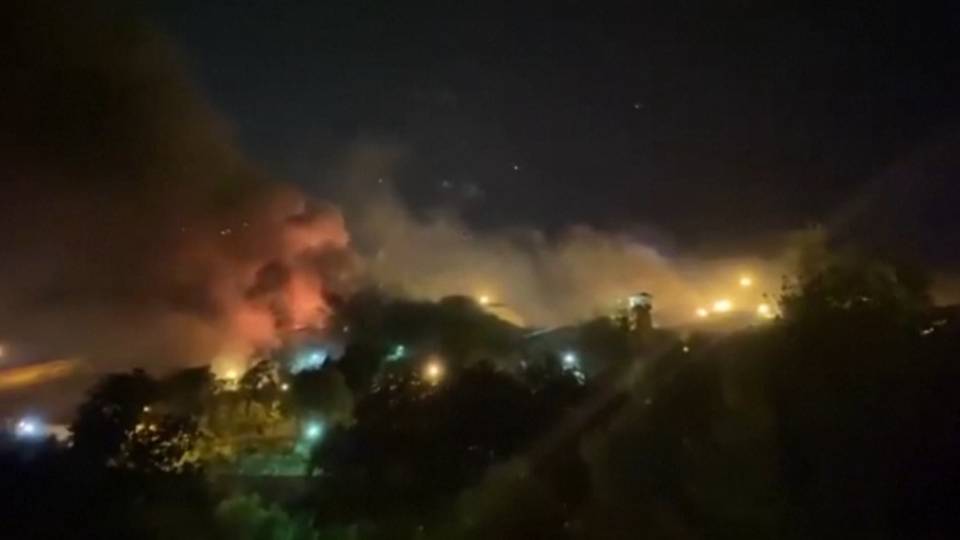
Fire Erupts at Iran’s Evin Prison as Anti-Government Protests Continue
Oct 17, 2022
In
Iran, a massive fire engulfed parts of Tehran’s infamous Evin prison
Saturday, killing at least eight people and injuring dozens of others.
It’s unclear exactly what happened, though Iranian state media reported
prisoners and guards clashed before the blaze erupted. Witnesses
reported hearing explosions and gunfire coming from the prison. Evin is
well known for housing political prisoners and anti-government
protesters. Many of its former captives have said they were mistreated
or tortured there. The blaze came as Iran remains roiled by mass
protests and just a day before the one-month anniversary of the death of
22-year-old Mahsa Amini, who died while in the custody of Iran’s
so-called morality police.
________ and this powerful poem below quoted from Portside
An Anthem From the Iranian Protests
On September 27, a song by Iranian musician Shervin Hajipour
‘broke’ Persian social media. He is singing of the mass protests that
began in Iran following the death of Jina (Mahsa) Amini. It went viral
-- viewed 40 million times within 48 hours.
For the Sake of…
For the sake of dancing in the alleys
Because of the fear you feel while kissing
For my sister – your sister – our sisters
To change the minds that have rotted away
Because of shame, because of being broke
Because of longing for a normal life
For the garbage-picking kid and his dreams
Because of this command economy
Because of this polluted air
For Valiasr Street and its worn-out trees
For Pirouz and his probable extinction
For innocent, forbidden dogs
Because of tears that never stop
For the image of a return to this moment
For the sake of a laughing face
For schoolkids, for the future
Because of this mandatory paradise
For imprisoned intellectuals
For Afghan children
Because of all of these becauses, no two the same
Because of all these empty slogans
Because of collapsing homes built on the cheap
For a feeling of peace
For the sun after long nights
Because of meds for depression and insomnia
For men, homeland, prosperity
For the girl that wished she was a boy
For women, life, freedom
For freedom
For freedom
For freedom
براى…
برای توی کوچه رقصیدن
برای ترسیدن به وقت بوسیدن
برای خواهرم خواهرت خواهرامون
برای تغییر مغزها که پوسیدن
برای شرمندگی برای بی پولی
برای حسرت یک زندگی معمولی
برای کودک زباله گرد و آرزوهاش
برای این اقتصاد دستوری
برای این هوای آلوده
برای ولیعصر و درختای فرسوده
برای پیروز و احتمال انقراضش
برای سگ های بی گناه ممنوعه
برای گریه های بی وقفه
برای تصویر تکرار این لحظه
برای چهره ای که میخنده
برای دانش آموزان برای آینده
برای این بهشت اجباری
برای نخبه های زندانی
برای کودکان افغانی
برای این همه “برای” غیر تکراری
برای این همه شعارهای تو خالی
برای آوار خونه های پوشالی
برای احساس آرامش
برای خورشید پس از شبای طولانی
برای قرصای اعصاب و بی خوابی
برای مرد میهن آبادی
برای دختری که آرزو داشت پسر بود
برای زن زندگی آزادی
برای آزادی
برای آزادی
برای آزادی
-Lyrics by Shervin Hajipour, translated by Zuzanna Olszewska
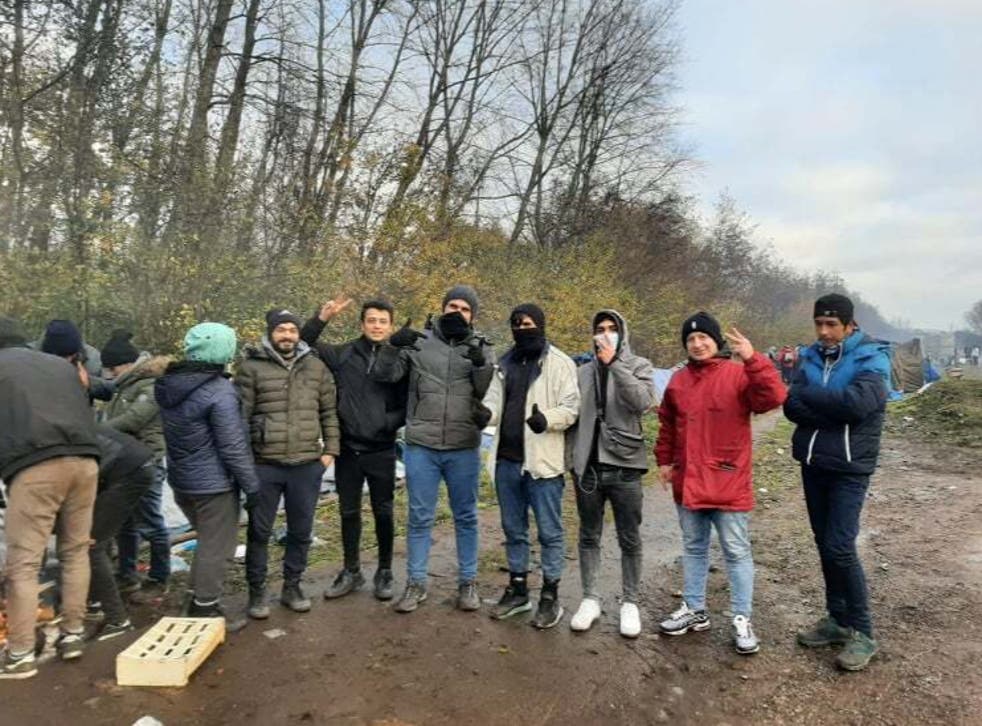
A group from Iraq and Iran stand near a fire in a campsite in Dunkirk in near-freezing temperatures.
They do not want to be in France.
But they are here, in a makeshift campsite near old train tracks in the
Grande-Synthe suburb, after failed attempts to cross the English Channel left them having to swim back to shore.
This happened four times, one of them says.
As
they wait for their next try, they are camping out in Grand-Synthe in a
site that has become popular with migrants since one nearby – which
housed more than 1,000 – was broken up by police last week.
Tents are pitched in rows of two or three along a narrow stretch of land, fitting in between an old railway line and a road.
Fires burn and smoke billows throughout the camp on a cold Saturday morning, with temperatures hovering just above freezing.
“People’s lives are very bad,” a young woman from Iraq tells The Independent
as she describes life in the camp. “There are no houses, it’s very very
cold, we don’t eat.” She laughs as she adds: “No shower.”
Others
in the group start listing what they are missing in the camp, including
money and clothes. “There isn’t anything,” one young man says.
At a bus stop on a nearby main road, Kurdish teenager Ali tells The Independent
he is looking to get a sleeping bag before heading to the campsite. He
has come to Europe with his brother from Iran, a country he says is
dangerous for certain people, including those in the LGBT+ community –
to which he belongs.
He hopes it will be safer in England, where his parents live. He is already able to speak English.
To get to Europe, the brothers spent five days on a boat with no food or space to sit down, according to Ali – who tells The Independent he is 18, and that one of his favourite singers is Billie Eilish.
Now,
they are thinking about taking another boat to England, which Ali says
is the cheaper option. “We spent all the money we had. Now we do not
have much money,” he says. “We have to go to England by boat.”
Other migrants in northern France tell The Independent
they feel they have no other option but to try to reach England by sea,
even if it puts their lives at risk, because it will give them the best
chance of a new life.
Pleas for safe routes to England have been renewed after the deadly shipwreck earlier this week, which killed 27 people including three children. Maryam Nuri Hamdamin, a 20-year-old woman hoping to reach her fiance in the UK, was the first victim to be named.
Migrants who ‘swam back to France’ after failed Channel crossing await another attempt
After a nearby camp was broken up by police, people with nowhere to go are camping on a disused railway line







Migrants who ‘swam back to France’ after failed Channel crossing await another attempt
After a nearby camp was broken up by police, people with nowhere to go are camping on a disused railway line